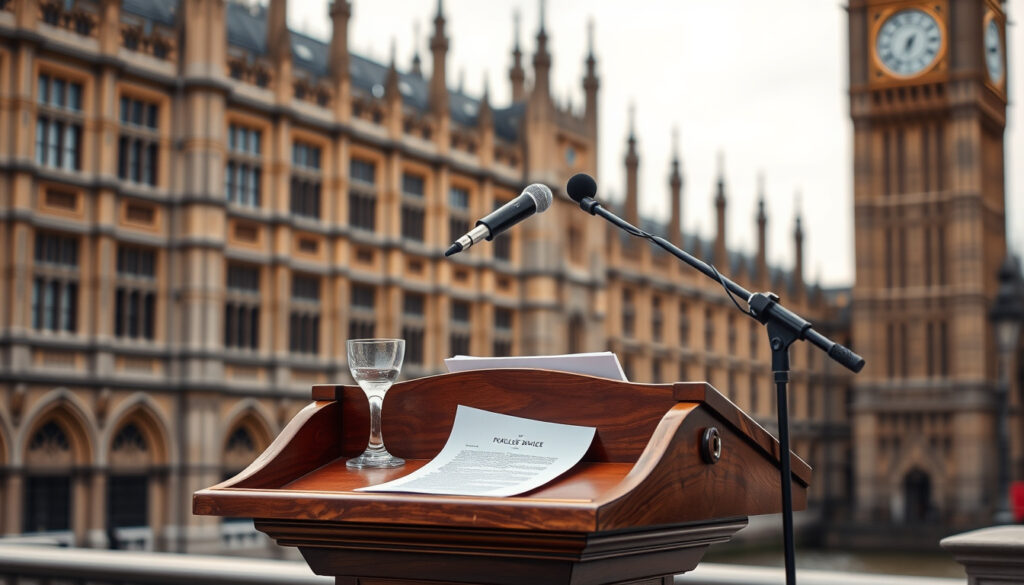
Neil Kinnock: Biography, Age, Net Worth, Speech, and More
Most people under 40 probably know Neil Kinnock as the man in the old news clips who never quite became Prime Minister, but there’s a lot more to his story. For the generation that lived through the 1980s and early 1990s, he was the Labour leader who steered his party back from the brink of extinction after its worst defeat in 1983.
Born: 28 March 1942 ·
Age: 82 ·
Political party: Labour ·
Leader of the Labour Party: 1983–1992 ·
Title: Baron Kinnock
Quick snapshot
- Born 28 March 1942 in Tredegar, Wales (Britannica)
- Labour Party leader 1983–1992 (Wikipedia)
- Son Stephen Kinnock is a Labour MP (BBC News)
- Exact net worth not publicly disclosed
- Some details of early personal life activities are less documented
- 1970: Elected MP for Bedwellty — start of 25-year Commons career
- 1985: Landmark anti-Militant speech
- Remains active in House of Lords as Baron Kinnock
- Son Stephen Kinnock continues the family’s political legacy
The pattern in the table below shows the key biographical markers that defined Kinnock’s public life.
| Label | Value |
|---|---|
| Full name | Neil Gordon Kinnock |
| Born | 28 March 1942, Tredegar, Wales |
| Political party | Labour |
| Leadership tenure | 2 October 1983 – 18 July 1992 |
| Predecessor | Michael Foot |
| Successor | John Smith |
| Spouse | Glenys Kinnock (m. 1967; died 2023) |
| Children | 2 (including Stephen Kinnock) |
How old is Neil Kinnock?
Neil Kinnock was born on 28 March 1942, which makes him 82-years-old as of 2024. He was born in Tredegar, Monmouthshire, Wales — a coal-mining town that shaped his early worldview and political identity (Britannica (encyclopedia)).
Neil Kinnock’s birth date and place
- Full name: Neil Gordon Kinnock
- Date of birth: 28 March 1942
- Place of birth: Tredegar, Monmouthshire, Wales
- Current age: 82
- Title: Baron Kinnock of Bedwellty (Wikipedia (political biography))
Early life and education
Kinnock attended University College, Cardiff (now Cardiff University), where he earned a degree in industrial relations and history. He also completed a postgraduate diploma in education (BBC News (UK public broadcaster)). After university, he worked for four years as an organizer and tutor for the Workers’ Educational Association (Britannica (encyclopedia)).
“I’ll tell you what happens with impossible promises. You start with far-fetched resolutions. They are then pickled into a rigid dogma. And you end with the grotesque chaos of a Labour council – a Labour council – hiring taxis to scuttle round a city handing out redundancy notices to its own workers.”
— Neil Kinnock, 1985 Labour Party Conference speech
Kinnock spent his early career as a left-wing rebel, yet the same anti-establishment instincts made him the party’s most effective internal reformer — turning his own former allies into targets of his critique.
What is Neil Kinnock’s net worth?
Neil Kinnock’s net worth is not publicly disclosed. Based on his pensions as a former MP, European Commissioner, and member of the House of Lords, plus book deals and advisory roles, independent estimates place it in the range of £1–5 million. Unlike some US or business figures, UK politicians of his generation rarely published personal wealth details.
Estimated wealth and sources
- Parliamentary pension from 25 years as an MP (1970–1995)
- European Commission salary as Vice-President (1999–2004)
- House of Lords daily attendance allowance and expenses
- Book royalties from works including Wales and the Common Market (1971) and As Nye Said (1980) — both early writings on Welsh politics and Bevanite socialism (Britannica (encyclopedia))
Post-political career earnings
After leaving the Commons, Kinnock served as European Commissioner for Transport, then as Vice-President of the European Commission from 1999 to 2004 (BBC Wales (public service broadcaster)). He was created a life peer in 2005, taking the title Baron Kinnock of Bedwellty (Wikipedia (political biography)). Peerages in the UK do not include a salary, but peers can claim expenses for attendance.
What was Neil Kinnock’s most famous speech?
His 1985 Labour Party Conference speech condemning the Militant Tendency is by far his most famous and enduring address. It defined his leadership at a critical moment and reshaped the party’s internal direction.
The 1985 Labour Party Conference speech
The speech was a direct attack on the far-left Militant Tendency, which had gained control of Liverpool City Council and pursued a strategy of confrontation with the Thatcher government. Kinnock’s line about “the grotesque chaos of a Labour council hiring taxis to hand out redundancy notices to its own workers” became one of the most quoted phrases in modern British political history.
“I’m telling you: if you have a Labour government and you’re in charge of a Labour council, you don’t get involved in that sort of lunacy.”
— Neil Kinnock, 1985 Labour Party Conference (as reported by BBC Wales (public service broadcaster))
Other notable addresses
Kinnock also delivered a passionate speech in April 1992 after the unexpected election loss to John Major. He opened by telling the party: “Listen to yourselves” — a line that captured both his frustration and his refusal to accept the result as a verdict on Labour’s values.
The 1985 speech didn’t just embarrass the Liverpool council — it gave Labour moderates a weapon to reclaim the party’s direction, effectively clearing the path for Tony Blair’s New Labour a decade later. Without Kinnock’s stand against Militant, the party’s modernisation might never have happened.
What previous offices did Neil Kinnock hold?
Kinnock held five major political roles over four decades. The pattern: each role moved him further from the left-wing rebel identity he started with and closer to the institutional establishment he once opposed.
These roles illustrate the arc of Kinnock’s career from backbencher to European administrator.
| Role | Period | Key detail |
|---|---|---|
| Member of Parliament (Bedwellty, later Islwyn) | 1970–1995 | Represented Welsh constituencies for 25 years |
| Leader of the Labour Party | 1983–1992 | Youngest leader in party history at 41 |
| Leader of the Opposition | 1983–1992 | Fought three general elections (1983, 1987, 1992) |
| European Commissioner for Transport | 1995–1999 | Appointed after leaving the Commons |
| Vice-President of the European Commission | 1999–2004 | Oversaw administrative reform of the Commission |
| Life Peer (Baron Kinnock of Bedwellty) | 2005–present | Sits in the House of Lords as a Labour peer |
Labour Party leadership
Kinnock became leader at the party conference in October 1983, succeeding Michael Foot after Labour’s catastrophic defeat in the 1983 general election (Britannica (encyclopedia)). At 41, he was the youngest leader in Labour’s history. He led the party through two further elections — 1987 and 1992 — losing both, though narrowing the Conservative majority each time.
European Commissioner and Vice-President
After leaving the Commons in 1995, Kinnock was appointed European Commissioner for Transport. In 1999 he became Vice-President of the European Commission under Romano Prodi, responsible for administrative reform (BBC Wales (public service broadcaster)). He is widely credited with cleaning up the Commission’s internal bureaucracy after the corruption scandals that forced the previous Commission to resign in 1999.
House of Lords
He was created a life peer in 2005 as Baron Kinnock of Bedwellty (Wikipedia (political biography)). He continues to attend the House of Lords and speaks on European affairs, Welsh matters, and constitutional issues. His wife Glenys Kinnock was also a Labour peer until her death in 2023.
Member of Parliament (25 years)
Kinnock was first elected in 1970 for the Welsh constituency of Bedwellty. Following boundary changes, he represented the successor seat of Islwyn from 1983 until his resignation in 1995 (Britannica (encyclopedia)). During his first decade in Parliament, he was associated with the party’s left wing, supporting unilateral nuclear disarmament and withdrawal from the European Economic Community.
Kinnock’s move from left-wing rebel to Brussels insider cost him some grassroots loyalty in Wales but gave him a global platform he would never have had as a defeated opposition leader. For Labour modernisers, the trade-off was worth it: his EU credibility helped normalise the party’s pro-European stance.
Who is Neil Kinnock’s son?
Neil Kinnock’s son is Stephen Kinnock, a Labour MP for Aberavon since 2015. Stephen has carved out his own political career, serving as a shadow minister and representing a Welsh constituency just a few miles from his father’s old seat.
Stephen Kinnock’s political career
- Elected as Labour MP for Aberavon in the 2015 general election
- Served as Shadow Minister for Asia and Pacific (2015–2016)
- Served as Shadow Minister for Immigration (2016–2017)
- Re-elected in 2017, 2019, and 2024
- Appointed as Minister of State for the Middle East in 2024 under Keir Starmer’s government
Stephen Kinnock is married to Helle Thorning-Schmidt, who served as Prime Minister of Denmark from 2011 to 2015. The couple have two daughters (BBC News (UK public broadcaster)).
Family background
Neil Kinnock married Glenys Parry in 1967. They had two children: Stephen (born 1970) and a daughter, Rachel. Glenys Kinnock was herself a Labour politician — she served as a Member of the European Parliament from 1994 to 2009 and was made a life peer in 2009. She died in December 2023 after living with Alzheimer’s disease for several years. Neil Kinnock has spoken publicly about the emotional toll of caring for her during her illness (BBC News (UK public broadcaster)).
Neil Kinnock’s political legacy
Kinnock never became Prime Minister. That single fact colours everything written about him. Yet the argument that he saved the Labour Party from electoral irrelevance is widely accepted by political historians (BBC Wales (public service broadcaster)). He took a party that had won just 27.6% of the vote in 1983 and rebuilt it into a credible opposition that, under John Smith and then Tony Blair, would eventually win the 1997 landslide.
“He was the man who began the journey of reform. He had the guts to take on the hard left and the Militant Tendency when others were too scared or too timid. For that, every Labour leader since owes him a debt.”
— Tony Blair, speaking about Kinnock’s role in modernising Labour
Timeline: Key events in Neil Kinnock’s life
- 28 March 1942 — Born in Tredegar, Wales
- 1970 — Elected MP for Bedwellty
- 1983 — Elected Leader of the Labour Party after Michael Foot’s resignation (Britannica (encyclopedia))
- 1985 — Delivers landmark speech against Militant Tendency at Labour Party Conference (BBC Wales (public service broadcaster))
- 1992 — Resigns as Labour leader after unexpected election defeat (BBC Wales (public service broadcaster))
- 1995 — Leaves the House of Commons; appointed European Commissioner for Transport
- 1999–2004 — Serves as Vice-President of the European Commission (Wikipedia (political biography))
- 2005 — Created life peer as Baron Kinnock of Bedwellty (Wikipedia (political biography))
Confirmed facts about Neil Kinnock
- Born 28 March 1942 in Tredegar, Wales (Britannica (encyclopedia))
- Labour Party leader from 2 October 1983 to 18 July 1992 (Wikipedia (political biography))
- Member of Parliament for 25 years (1970–1995) (Britannica (encyclopedia))
- Vice-President of the European Commission 1999–2004 (BBC Wales (public service broadcaster))
- Created a life peer in 2005 as Baron Kinnock of Bedwellty (Wikipedia (political biography))
- Son Stephen Kinnock is a Labour MP and government minister (BBC News (UK public broadcaster))
- Married Glenys Kinnock in 1967; she died in 2023 (BBC News (UK public broadcaster))
- Youngest Labour Party leader in history when elected at age 41 (Britannica (encyclopedia))
- Educated at University College, Cardiff with a degree in industrial relations and history (BBC News (UK public broadcaster))
- Authored Wales and the Common Market (1971) and As Nye Said (1980) (Britannica (encyclopedia))
What remains unclear about Neil Kinnock’s life
- Exact net worth — not publicly disclosed; independent estimates range from £1–5 million
- Some details of his early personal and educational activities are less documented than his political career
- The full extent of his influence on specific EU policies during his Commission tenure is not easily verifiable from public sources
imdb.com, iai.tv, youtube.com, msr.icx.mlga.ek.gov.ng, forgepress.org, encyclopedia.com, iis.berkeley.edu, iai.tv
Frequently asked questions
What is Neil Kinnock’s full name?
Neil Gordon Kinnock, Baron Kinnock of Bedwellty.
What is Neil Kinnock’s role in the House of Lords?
He sits as a Labour life peer, created in 2005, and speaks on European affairs, Welsh matters, and constitutional issues.
What was Neil Kinnock’s education?
He studied industrial relations and history at University College, Cardiff and gained a postgraduate diploma in education.
What are Neil Kinnock’s major achievements?
He is credited with modernising the Labour Party after its 1983 defeat, confronting the Militant Tendency, and later reforming the European Commission’s administration.
How did Neil Kinnock become a peer?
He was created a life peer in 2005 on the recommendation of the House of Lords Appointments Commission, recognising his political service.
What is Neil Kinnock’s relationship with the Labour Party today?
He remains a supportive figure, attending the House of Lords as a Labour peer, but is no longer an active party strategist.
Did Neil Kinnock ever become Prime Minister?
No. He led Labour through three general elections (1983, 1987, 1992) and lost all three, resigning after the 1992 defeat.
What is Neil Kinnock’s connection to the European Union?
He served as European Commissioner for Transport and later Vice-President of the European Commission, playing a key role in post-corruption administrative reform.
Related reading
- George Osborne – Career, Net Worth, Family and Current Roles
- French Presidents – Complete List from 1945 to Present
The pattern across Kinnock’s career is clear: a left-wing rebel who became the party’s disciplinarian, a European sceptic who ended up administering the EU, a leader who never won the top job but made the next victory possible. For any Labour leader after him, the lesson is not about election tactics — it’s about the courage to take on your own side when the party’s future hangs in the balance. Kinnock’s legacy forces a question that still echoes: what would have happened if he had won?
More related posts
 When Does the Time Change? Ireland Clock Change 2025-2026
 Scottish Grand National 2025 – Captain Cody Wins at Ayr
 Diana Rigg: Cause of Death, Illness, Net Worth, and Legacy
 Federico Chiesa: Stats, Partner, Transfer & Career 2026
 Joe Hendry: WWE Status, Real Name, Career, and Viral Song
 Second Hand Electric Cars Ireland: 2026 Guide & Costs
 Duke of Kent: Relationship to Queen, Inheritance & Funeral
 Syd Barrett’s mental decline, death, and Pink Floyd fallout