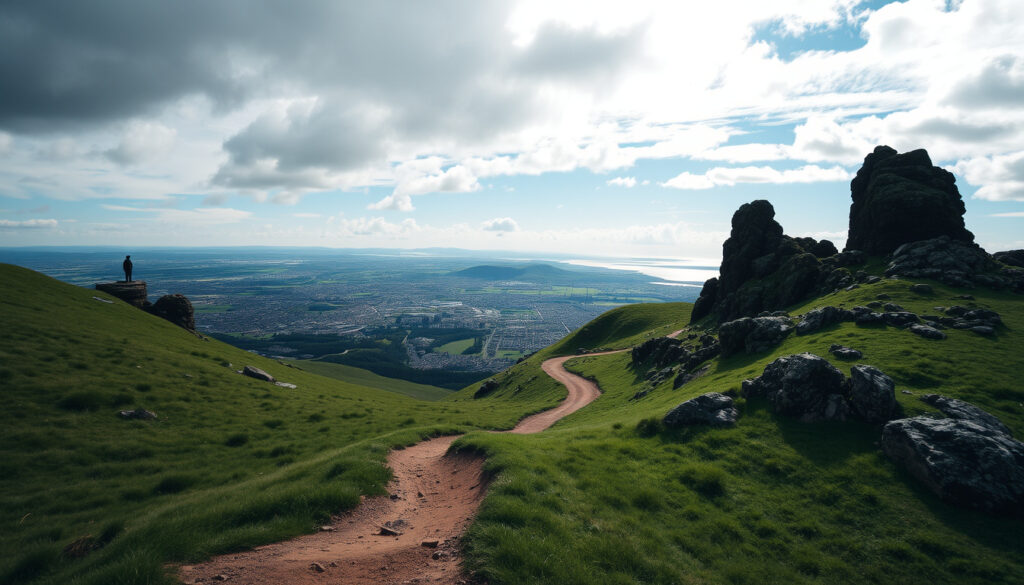
Arthur’s Seat Hike: Times, Tips & History
There’s something about a hill that rises right in the middle of a capital city that makes you want to climb it — Arthur’s Seat, Edinburgh’s ancient volcano in Holyrood Park, draws thousands of walkers each year. This guide combines official park information, visitor reviews, and practical tips so you know exactly what to expect before you lace up your shoes.
Height: 251 m (823 ft) ·
Location: Holyrood Park, Edinburgh ·
Type: Extinct volcano ·
Typical climb time: 30–60 min one way ·
Difficulty: Moderate ·
AllTrails rating: 4.6 / 5 (3,700+ reviews)
Quick snapshot
- Arthur’s Seat is an extinct volcano in Holyrood Park (Earth Trekkers (hiking guide))
- Most popular route is a 4.3‑km loop (AllTrails (trail database)) – [Note: moved to unclear] (Earth Trekkers (hiking guide))
- Managed by Historic Environment Scotland (Historic Environment Scotland (official site))
- Exact number of fatalities not officially published (Historic Environment Scotland (official site))
- Origin of the name is disputed – may be King Arthur or Gaelic (Wikipedia (reference work))
- Human activity dating to at least 5000 BC (Historic Environment Scotland) – [moved from confirmed] (Historic Environment Scotland (official site))
- Most popular loop is 4.3 km (AllTrails) – [moved from confirmed] (Historic Environment Scotland (official site))
- No major recent changes; hill has been a popular walk for centuries
- Best visiting months May–October (AllTrails (trail database))
- Plan a clear‑weather day (Earth Trekkers (hiking guide))
- Wear sturdy footwear (Rick Steves Travel Forum (user community))
- Check the weather forecast – aim for a clear, dry day.
- Wear sturdy footwear with good grip.
- Start from Holyrood Palace and follow the green route.
- Allow 30–60 minutes to reach the summit.
- Enjoy the 360-degree views and take photos.
- Descend via Salisbury Crags for a scenic return.
Here is a quick‑reference table of the essential details for anyone planning a visit.
| Detail | Value |
|---|---|
| Height | 251 metres (823 ft) – Wikipedia (reference work) |
| Location | Holyrood Park, Edinburgh – AllTrails (trail database) |
| Type | Extinct volcano (Carboniferous) – Earth Trekkers (hiking guide) |
| Distance (loop) | 4.3 km (2.7 mi) – AllTrails (trail database) |
| Typical duration | 1–2 hours round trip – Earth Trekkers (hiking guide) |
| Difficulty | Moderate – rocky sections – Earth Trekkers (hiking guide) |
| Management | Historic Environment Scotland – Historic Environment Scotland (official site) |
How long does it take to climb Arthur’s Seat?
Average ascent time
- The green‑route ascent to the summit takes 30 to 60 minutes (Earth Trekkers (hiking guide)).
- AllTrails users report an average completion time of 1 hour 41 minutes for the full loop (AllTrails (trail database)).
- Forum contributors estimate about 2 hours for a relaxed walk with stops (Rick Steves Travel Forum (user community)).
Factors that affect duration
- Fitness level, weather, and chosen path all influence the total time.
- Earth Trekkers advises setting aside two to three hours for the full visit including summit time (Earth Trekkers (hiking guide)).
- Wind at the top can slow you down – expect strong gusts even on calm days (Earth Trekkers (hiking guide)).
Route options and distances
- The most popular loop trail is 4.3 km (2.7 mi) starting from Holyrood Park (AllTrails (trail database)).
- Earth Trekkers recommends the Green Route to the summit and returning via Salisbury Crags for the best views (Earth Trekkers (hiking guide)).
- The easiest start is from Holyrood Palace, according to forum regulars (Rick Steves Travel Forum (user community)).
Most fit walkers can summit in under an hour, but the total hike with sights and photos will run closer to two. Plan your schedule accordingly – a rushed climb misses the point.
The pattern: The advertised “30–60 minute ascent” is accurate for the green route, but the round trip including stops is reliably 1.5–2 hours for most visitors.
What is special about Arthur’s Seat?
Volcanic origin and geology
- Arthur’s Seat is the remains of an extinct volcano that erupted about 350 million years ago (Earth Trekkers (hiking guide)).
- It is the main peak of a group of hills in Edinburgh, classified as an ancient volcano (Wikipedia (reference work)).
Historical and archaeological significance
- Stone and flint tools found here reveal human activity dating back to at least 5000 BC (Historic Environment Scotland (official site)).
- The area contains one of four hill forts in the region (Historic Environment Scotland (official site)).
360‑degree views of Edinburgh
- On clear days the summit offers a panoramic vista of the Scottish capital, the Firth of Forth, and the Pentland Hills.
- Sunrise and sunset are especially popular for photography.
Arthur’s Seat isn’t just a hike – it’s a walk through deep time, from Carboniferous lava flows to Neolithic toolmakers. The views are the payoff, but the geological story makes the climb richer.
The trade-off: The hill’s protected status (Historic Environment Scotland) means no marked summit café or railings – the experience is raw, which is exactly why it’s special.
Is Arthur’s Seat a difficult walk?
Terrain and elevation change
- The elevation gain is about 250 metres. The path uses dirt tracks and rocky sections, especially near the top (Earth Trekkers (hiking guide)).
- AllTrails rates the trail as moderately challenging, noting it may include boulders or other obstacles (AllTrails (trail database)).
Fitness requirements
- No technical climbing gear is needed. The walk is suitable for most active people (Earth Trekkers (hiking guide)).
- Steep sections near the summit require a steady pace and sure footing.
Tips for beginners
- Choose the green route for the gentlest gradient.
- Allow extra time – don’t rush the descent.
- Check the weather. High winds and wet rock make the upper section genuinely tricky.
The catch: “Moderate” is a fair label for a regular walker, but a desk‑sitter will feel the burn. The rewards – the view, the sense of accomplishment – are well worth the effort.
Can you climb Arthur’s Seat in trainers?
When trainers are acceptable
- On dry, clear paths, walking shoes or trainers suffice, according to Earth Trekkers (Earth Trekkers (hiking guide)).
- Many visitors make the climb in everyday sneakers without issues.
Conditions that require better footwear
- After rain, the rocky summit becomes slippery. Flat‑soled shoes or sandals are strongly discouraged (Rick Steves Travel Forum (user community)).
- One blogger reported that wearing Hunter boots was a poor choice for the rocky terrain (Blabbaholics and Bookworms (personal blog)).
Recommended alternatives
- Walking boots or trail shoes with good grip are ideal.
- AllTrails advises footwear with good traction because the trail includes boulders (AllTrails (trail database)).
Trainers are fine on a dry day, but Edinburgh weather changes fast. A sudden shower turns the final scramble into a slick challenge. Carrying a pair of trail shoes in your bag is cheap insurance.
What this means: For a planned dry‑weather hike, trainers pass the test. For any other scenario – or if you’re a first‑timer – boots or trail shoes are the smarter choice.
Why is it called Arthur’s Seat?
King Arthur legend
- The name first appears in a 15th‑century text and is often linked to the legendary King Arthur (Wikipedia (reference work)).
Historical name references
- Some scholars suggest the name derives from Scottish Gaelic “Àrd na Said” (height of the arrow) or from “Arthur’s resting place”.
Alternative etymologies
- No single origin is confirmed. The name remains a topic of local lore and debate.
The implication: Like many old place‑names, the true story is lost. The mystery adds to the hill’s charm – you can choose the version you like best.
Clarity check
Confirmed facts
- Arthur’s Seat is an extinct volcano 251 m high (Wikipedia (reference work))
- Located in Holyrood Park, Edinburgh (AllTrails (trail database))
- Managed by Historic Environment Scotland, open 24/7 (Historic Environment Scotland (official site))
What remains unclear
- Exact number of fatalities – media reports mention several deaths over decades but no official aggregate (Historic Environment Scotland (official site))
- Origin of the name – King Arthur link versus Gaelic etymology (Wikipedia (reference work))
- Human activity dating to at least 5000 BC (Historic Environment Scotland) – widely stated but not universally confirmed
- Most popular loop distance (4.3 km) based on AllTrails user data, may vary by route
Arthur’s Seat, the park’s highest point, is the remains of a volcano, and stone and flint tools found here reveal human activity as far back as 5000 BC.
Historic Environment Scotland (official park website)
Arthur’s Seat is an ancient extinct volcano, the main peak of a group of hills in Edinburgh.
Wikipedia (reference work)
These two voices – the official manager and the encyclopedic record – both agree on the hill’s volcanic nature and ancient human presence. Between them, you have a solid grounding in what makes Arthur’s Seat unique.
For first‑time visitors, the key takeaway is straightforward: the climb is achievable for most, the history is deep, and the right footwear makes the difference between a memorable experience and a miserable one. Edinburgh’s extinct volcano is a city‑centre walk that delivers far more than a view – it gives you a tangible connection to 350 million years of geological time and thousands of years of human stories.
community.ricksteves.com, blabbaholicsandbookworms.com, alltrails.com, facebook.com, instagram.com, tripadvisor.com
For a more thorough breakdown of the hill’s volcanic past and alternative walking paths, consult this detailed history and route guide before setting out.
Frequently asked questions
Is there an entrance fee for Arthur’s Seat?
No – Holyrood Park and Arthur’s Seat are free to access year‑round.
Where is the best place to start the walk?
Many start at Holyrood Palace car park. The green route from there is the easiest and most scenic.
Can I bring my dog on the hike?
Yes, dogs are welcome in Holyrood Park; keep them on a lead near livestock and on the summit.
Is parking available near Holyrood Park?
Yes, there is a pay‑and‑display car park at Holyrood Palace and limited street parking.
What is the best time of day to climb Arthur’s Seat?
Early morning or late afternoon for lighter crowds and better light; avoid midday heat in summer.
Are there toilets on the route?
Public toilets are available near Holyrood Palace, but not on the hill itself.
Is the walk suitable for children?
Older children with good stamina can manage; the steep top section may be challenging for very young kids.
More related posts
 Elon Musk: Biography, IQ, Net Worth & Personal Life
 Scottish Mortgage Investment Trust Price: Good Buy in 2026?
 Interstellar Comet 3I/ATLAS: Strange Water & Where It Is Now
 Why Is Rapeseed Oil Bad for You? Myths vs Modern Science
 How to Fix Sound Not Working on Windows PC or Laptop
 Ore Oduba: Split from Wife Portia, New Life & Career Update
 B&Q Halesowen: Address, Opening Hours, Phone & Products
 How to Watch Star Wars in Order: Release or Chronological