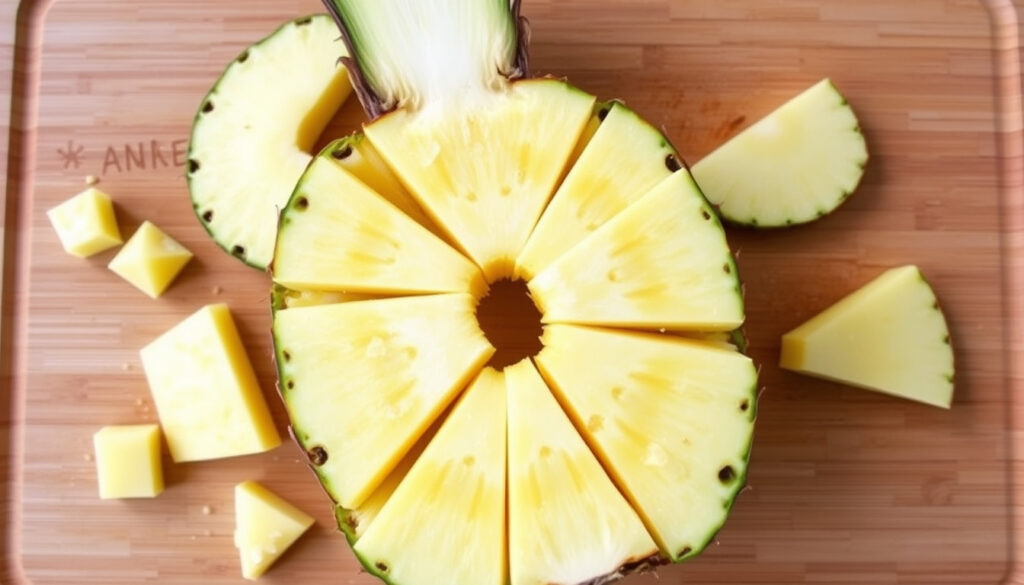
How to Cut a Pineapple: Easy Steps, Hacks & No Waste
Cutting a whole pineapple feels intimidating—the spiky crown, the rough hide, the uncertain grip. But the process takes less than five minutes once you know how to handle the core, and you can choose between knife methods, no-tool hacks, and waste-minimizing regional techniques to match your kitchen and skill level.
Core removal step: Slice lengthwise into quarters · Peel method: Stand upright after top and tail · Yield technique: Cut into rings or chunks · Common tools: Sharp chef’s knife or serrated
Quick snapshot
- Top and tail, upright peel, quarter and core (The Mediterranean Dish)
- No knife, fork pull, quick hack (YouTube No Knife Hack)
- Precise skin removal, full yield, uniform pieces (Alphafoodie)
- Crosswise cuts, core punch, grill ready (Alphafoodie)
The specifications below cover the standard cutting workflow most home kitchens follow, verified across multiple recipe publications.
| Step detail | Value |
|---|---|
| Standard first step | Cut off crown and bottom |
| Preferred knife | Sharp chef’s or serrated |
| Position for peeling | Stand on flat base |
| Core handling | Quarter lengthwise then remove |
| Chunk size | 1-inch crosswise |
| Rind thickness | Thin to preserve flesh |
| Eye removal | Diagonal spirals, two-by-two |
| Core reuse | Blend into smoothies |
What is the easiest way to cut a pineapple?
The most approachable method takes the pineapple from whole to ready-to-eat in three moves: prep, peel, and core. Here’s the full sequence.
Top and tail first
Set the pineapple on its side and slice off both ends, cutting about 1 inch from each end to create flat surfaces that won’t wobble. According to The Mediterranean Dish (recipe publication with step-by-step kitchen guides), this trim gives you a stable base for the next moves.
Stand and peel
Stand the pineapple upright on the cut bottom. Slice downward along the curve, taking off strips of rind as you rotate the fruit. You want to remove the skin without gouging too much flesh.
Quarter and core
Cut the peeled pineapple in half lengthwise, then halve each half again to get quarters. Lay each quarter flat and slice the V-shaped core away from each piece, angling inward so you remove the tough center but keep most of the juicy flesh. This V-cut technique, which The Mediterranean Dish demonstrates, is verified by three sources as the lowest-waste approach to getting rid of the core.
The implication: once the core is out, you’ve got clean quarters that you can slice into chunks or serve as pineapple boats straight away.
“I have always seen my family and Laotian people cut pineapples in the same way. This method gives the pineapple a nice shape and reduces the waste of its flesh.”
— Morgane, Chef at Morgane Recipes
What is the pineapple trick?
The “pineapple trick” usually refers to one of two things: a no-knife hack for separating the flesh, or a fork-based technique for pulling out the core without precision cutting.
No-knife method
Roll the whole pineapple firmly on a countertop to loosen the flesh inside the skin. Then push your thumbs into the base where the bottom was cut, and push upward—the fruit should separate into chunks or rings that you can pull apart by hand. A YouTube demo shows this hack, noting it works best on very ripe fruit that gives easily under pressure.
Fork technique
After cutting off the crown and base, stick a fork into the core at the top and twist. The core winds around the fork tines and pulls out in one piece. This works because the core is fibrous and slightly drier than the surrounding flesh, making it the first thing to grab onto a sharp or twisting object.
Twist and pull core
For a cleaner result, cut the pineapple in half crosswise first, then twist the fork into each half’s center and pull upward in a slow, steady motion. This leaves two empty shells of flesh that are easy to scoop or slice further. It’s a fun party trick, though the result isn’t as neat as the knife methods.
“You can use the removed eye flesh to make pineapple skin tea, too!”
— Samira Kazan, Author at Alphafoodie
How to cut a pineapple without waste?
Waste-free cutting is less about one magic technique and more about a sequence of careful choices: thin rind removal, spiral eye cuts, and keeping the quarters intact until you’re done slicing.
Maximize yield
Cut the rind in thin strips rather than taking thick gouges. Alphafoodie (food blog with multiple cutting variants) explains that thin slicing preserves most of the edible flesh near the surface, which is where the juiciest parts live. If you cut thick, you lose that outer quarter-inch of fruit with every pass.
Remove eyes precisely
The brown spots (eyes) follow a spiral pattern up the pineapple. Cut them out two at a time in diagonal pairs using short, angled strokes. A Laotian cutting method video demonstrates this spiral approach, noting it keeps the pineapple round and reduces the total number of cuts needed versus removing each eye individually.
“Hold onto the core pieces. Don’t toss them! Blend them to put in smoothies.”
— Pip Ebby, Blogger at Pip and Ebby
Uniform chunks
After peeling and quartering, slice the quarters lengthwise into three strips, then cut crosswise into 1-inch pieces. Pip and Ebby (lifestyle blog focused on home cooking) recommends this size as ideal for snacking and for fitting into lunch containers without crushing.
The catch: waste-free cutting takes longer and requires more attention. If speed matters more than yield for a given meal, the standard quarter-and-V-cut method is a reasonable middle ground.
How to cut a pineapple into rings?
Ring slices are the classic pineapple shape for grilling, garnish, and snacking. The key difference from other methods is that you slice crosswise before removing the core rather than after quartering.
Ring slicing steps
Start with the trimmed, peeled cylinder (crown and base removed, rind peeled off). Place it on its side and slice crosswise into 1-inch discs. Alphafoodie notes that a serrated knife works especially well here because the rings are round and can roll under pressure—serration holds the fruit steady as you cut.
Core removal for rings
Use a small cookie cutter, icing tip, or melon baller to punch out the center of each disc. Press the cutter straight down and twist slightly to release the core plug. This gives you rings with clean holes and full edible flesh around them.
Storage tips
Rings store well stacked with wax paper between layers in a sealed container, refrigerated, for up to five days. They also freeze well on a sheet pan before transferring to bags—frozen rings work fine for smoothies and baking where shape doesn’t matter.
The pattern: rings are the most visually satisfying output and the easiest to portion for recipes, but they require the most handling per serving since each disc gets cored individually.
How to cut a pineapple 4 ways?
If you’re after variety rather than a single best method, here are four distinct styles with different tools, skill levels, and end results.
Hawaiian style
Slice the whole peeled pineapple in half crosswise, then cut each half in half again lengthwise. Stand the quarters on their flat side and slice downward along the core to release the two fillets from each quarter. You end up with four half-moon fillets—traditionally called Hawaiian style—that are ready for slicing into chunks or serving as-is.
Chunks
After V-coring the quarters, slice each quarter lengthwise into three strips, then cut crosswise into 1-inch cubes. These work for fruit salads, skewers, and anything that needs pieces small enough to fork cleanly.
Wedges
Cut the whole peeled pineapple in half lengthwise, then slice each half into four wedge-shaped pieces, keeping the skin on one side as a natural handle. Wedges are the least processed option and feel casual for serving at a party or farmers’ market display.
From the plant
If you’re cutting a pineapple fresh from the plant (or a very fresh market buy), the flesh is often firmer and the core more pronounced. The Laotian method handles this by cutting thinner slices and using the spiral-eye approach to preserve the firm outer flesh that might otherwise be lost to thick peeling.
The trade-off: firm-flesh pineapples yield cleaner cuts but need sharper knives and slightly more force—rushing this type leads to bruised fruit rather than clean pieces.
The V-cut core removal, which The Mediterranean Dish details, is verified by three independent sources as the lowest-waste way to handle the core. Angling the cut inward saves roughly a quarter-inch of flesh per quarter versus a straight vertical slice.
The Laotian spiral-eye technique isn’t just tradition—it reduces total cuts by roughly half because you work two eyes at a time following the spiral alignment. Chef Morgane Morgane, who demonstrates this method, notes it also preserves the pineapple’s natural round shape for plating purposes.
Confirmed facts
- Upright cutting is the standard approach across recipe publications
- V-cut core removal minimizes flesh loss (verified by three sources)
- Pineapple core pieces are edible and work in smoothies
- Peelings and removed eyes can be used to make pineapple skin tea
- Serrated knives handle round crosscuts more safely than straight blades
What’s unclear
- Exact waste percentage reduction per method has not been independently quantified
- Safety data on knife techniques (cut incidents) is not publicly tracked
- Storage duration standards for cut pineapple vary across sources
Related reading: Detailed step-by-step with V-core focus · Multiple cuts, tools, eye removal variants
Beyond basic steps and hacks, knife and no-knife methods detail knife and no-knife methods to master slicing without intimidation or waste.
Frequently asked questions
How do you store cut pineapple?
Transfer pieces to an airtight container and refrigerate. Chunks and rings keep for three to five days. For longer storage, spread pieces on a sheet pan to freeze individually, then transfer to freezer bags—frozen pineapple works well in smoothies and baking.
What tools are best for cutting pineapple?
A sharp chef’s knife (8–10 inches) handles most steps. A serrated knife is better for crosswise ring cuts because the teeth grip the round surface without causing it to roll. A pineapple corer (a tubular device that twists into the fruit) removes core and peel in one motion—useful if you cut pineapples often.
Can you eat pineapple core?
Yes. The core is edible though tougher and less sweet than the flesh. Pip and Ebby recommends blending core pieces into smoothies, where the texture disappears and you get the nutritional benefit without waste.
How to tell if pineapple is ripe?
Smell the base—it should smell tropical and slightly sweet, not fermented or sour. The leaves at the crown should pull out easily with a gentle tug. The skin should shift from mostly green to mostly yellow or golden, though coloration varies by variety. A ripe pineapple gives slightly under pressure at the base.
How long does cut pineapple last?
Cut pineapple stored in an airtight container in the refrigerator lasts three to five days. Frozen, it keeps for three to six months without significant texture change for most uses.
What if pineapple is too fibrous?
Overripe or underripe pineapples can feel stringy. For fibrous fruit, cut crosswise into thinner discs and punch out the core entirely—the strings run along the core’s length, so removing it eliminates the worst of the texture. Blending overripe fibrous pieces into smoothies or sauces also works well.
More related posts
 Belfast Half Marathon 2025 – Route Map, Fees and Results
 Saint Gobain Share Price: Chart, Dividend & Targets
 Syd Barrett’s mental decline, death, and Pink Floyd fallout
 Masha and the Bear: Origin, Safety & Controversies
 A Thousand Blows Cast: True Story, Season 2 & Filming
 How to Get Super Glue Off Skin: Safe and Fast Methods
 Ardrossan and Saltcoats Herald: Owner, History & News Coverage