Away in a Manger Lyrics: Full Text, History & Meaning
There’s a reason “Away in a Manger” feels like a bedtime story set to music — it began not as a grand hymn but as an unsigned poem in a nineteenth‑century Sunday‑school paper. First published in 1882, the carol slipped into print with no author’s name, setting off a century of lyrical tweaks and mistaken attributions, untangling a history of quiet mystery and enduring warmth.
First known publication: 1882 (in “The Little Corporal”) ·
Number of verses (common): 3 ·
Hymnal inclusion count: Over 500 hymnals ·
Major tunes: Mueller (USA) and Cradle Song (UK)
Quick snapshot
- The carol first appeared in print in 1882 (Hymnary.org, authoritative hymn database).
- It is not by Martin Luther (The Good and the Beautiful, faith‑based publisher).
- Three verses are the modern standard (Wikipedia, community‑edited encyclopedia).
- The exact author of the first two verses is unknown (Hymnary.org).
- Whether the original was intended as a lullaby remains debated. (Hymnary.org)
- Which tune is the “original” is disputed (Hymnology Archive, academic hymn research site).
- Whether the carol was originally intended for children’s Sunday school remains unconfirmed. (Hymnary.org)
- 1882 – First known publication (Hymnary.org).
- 1885 – Published in The Myrtle misattributed to Luther (Hymnology Archive).
- 1887 – James R. Murray composes the Mueller tune (The Good and the Beautiful).
- 1900s – Third verse added by John T. McFarland (Wikipedia).
- The carol continues to be recorded by major artists (Classic FM, UK radio network).
- Hymnal inclusion expands across denominations. (Classic FM, UK radio network)
Five key facts set the stage for understanding this carol’s evolution.
| Fact | Details |
|---|---|
| First published | 1882 (Hymnary.org) |
| Original language | English |
| Number of verses (standard) | 3 |
| Common tune | Mueller (by James R. Murray) (The Good and the Beautiful) |
| Hymnal classification | Christmas hymn / carol |
Is “Away in a Manger” a hymn?
The carol appears in hundreds of Protestant hymnals, but its classification as a hymn versus a carol has long been debated. A hymn typically is a structured song of praise addressed to God, while a carol is narrative and often tied to a specific season. “Away in a Manger” straddles both: its lyrics are a prayer‑like address to Jesus, but its storytelling is unmistakably that of a carol.
Definition of a hymn
- Hymns are typically sung by a congregation, have regular meter, and express communal worship.
- “Away in a Manger” uses meter 11.11.11.11 (Hymnary.org, authoritative hymn database), a common hymn meter.
Why this carol is often called a hymn
- The third verse is a direct prayer: “Be near me, Lord Jesus, I ask Thee to stay.”
- It is included in hymnals under the “Christmas hymns” section.
Official status in hymnals
- Hymnary.org lists it as a traditional carol and notes it appears in over 500 hymnals.
For congregations, the carol’s hybrid status means it works equally well as a gentle hymn during a Christmas Eve service and as a simple carol in a children’s pageant.
The pattern: Its classification is less about strict genre rules and more about its dual role as both a prayer and a story.
What are the lyrics to “Away in a Manger”?
The most common version heard today joins the original two verses from 1885 with a third verse added by John T. McFarland in 1892.
Traditional first verse
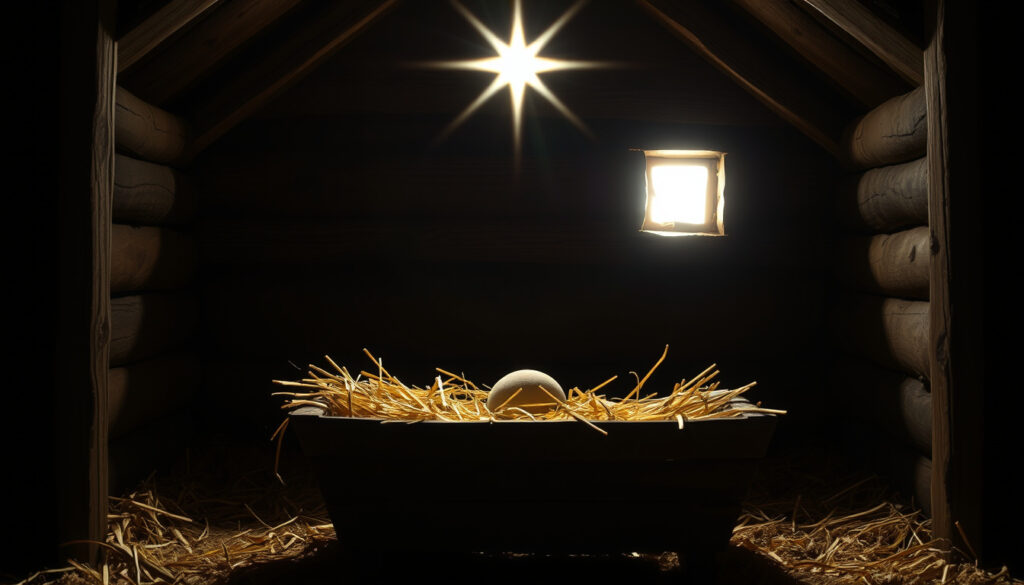
Away in a manger, no crib for a bed,
The little Lord Jesus laid down His sweet head.
The stars in the bright sky looked down where He lay,
The little Lord Jesus, asleep on the hay.
This verse has been consistent across nearly all editions (Hymnary.org).
Second verse (common)
The cattle are lowing, the Baby awakes,
But little Lord Jesus, no crying He makes.
I love Thee, Lord Jesus, look down from the sky,
And stay by my side until morning is nigh.
Some hymnals replace “stay by my side” with “stay by my cradle” (Luke Powell Ministries, hymn historian).
Third verse (added later)
Be near me, Lord Jesus, I ask Thee to stay
Close by me forever, and love me, I pray.
Bless all the dear children in Thy tender care,
And fit us for heaven to live with Thee there.
This verse first appeared in Gabriel’s Vineyard Songs (1892) (Wikipedia).
Variants in wording (thee vs him)
- Some modern recordings change “looked down where He lay” to “looked down where he lay” (GodTube, Christian media hub).
- The phrase “stars in the bright sky” sometimes appears as “stars in the heavens”.
Small word changes shift the carol’s tone from a reverent hymn to a more intimate lullaby, affecting which version churches choose for worship.
The trade-off: Preserving the original wording respects history; adapting it can make the carol more relatable for children.
How many verses does “Away in a Manger” have?
The number of verses varies by hymnal, but three is the accepted standard today.
The two‑verse original
- The 1885 publication in The Myrtle included only two verses (Hymnology Archive).
The three‑verse standard
- McFarland’s third verse was quickly adopted, and by the early 20th century most hymnals printed all three.
Four‑verse editions (rare)
- Some collections add a fourth stanza by McFarland that begins “Lord Jesus, I love Thee, I know Thou art mine…” but it is not widely used.
The implication: The addition of the third verse transformed the carol from a simple narrative into a personal prayer, broadening its appeal.
What is the most loved Christmas hymn?
Surveys and editorial lists regularly place “Away in a Manger” among the top Christmas carols. Classic FM includes it in its roster of the 30 greatest carols of all time (Classic FM, UK radio network).
Why “Away in a Manger” appears in top lists
- Its lullaby melody and gentle lyrics appeal to all ages.
- It is one of the first carols many children learn.
Survey results and Classic FM ranking
- Classic FM calls it “a timeless favourite” that consistently ranks high in listener polls.
Comparison with other hymns like “Silent Night”
- “Silent Night” often tops general Christmas lists, but “Away in a Manger” wins in categories focused on children’s carols.
While “Away in a Manger” is widely loved, its authorship confusion means few people know the real story behind the carol they sing.
Why this matters: The carol’s popularity ensures its lyrics — and the myths around them — continue to spread.
What is the history and origin of “Away in a Manger”?
The carol’s journey from a signed poem to a global carol is marked by a persistent false attribution and a slow accretion of verses.
Attribution myths
- James R. Murray titled the hymn “Luther’s Cradle Hymn” and claimed Martin Luther wrote it for his children (The Good and the Beautiful).
- Hymnologist William J. Reynolds states, “There is no evidence that Martin Luther wrote it” (Hymnology Archive).
First known publication (1882)
- The earliest known print appearance was in the periodical The Little Corporal in 1882, though the text was likely anonymous.
- In 1885 it appeared in The Myrtle with a note attributing it to Luther (Hymnology Archive).
Popularization and musical settings
- James R. Murray composed the tune “Mueller” for the carol in 1887.
- A separate tune, “Cradle Song,” became popular in the UK later.
- The tune was later renamed MUELLER after being attributed to Carl Müller in 20th‑century collections (Hymnology Archive).
The myth of Luther’s authorship actually helped the carol spread — Americans in the late 1800s were fascinated by anything tied to the Reformation.
The pattern: The carol’s origin story is less a clean historical record and more a case study in how misinformation can become beloved tradition.
Timeline
- : First known publication in The Little Corporal (anonymous) (Hymnary.org).
- : Published in The Myrtle with false attribution to Martin Luther (Hymnology Archive).
- : James R. Murray composes the “Mueller” tune (The Good and the Beautiful).
- : Third verse added by John T. McFarland in Gabriel’s Vineyard Songs (Wikipedia).
- : Widespread adoption in churches and schools worldwide.
The pattern: From an anonymous poem to a globally recognized carol, the timeline reflects a steady accretion of verses and tunes across two centuries.
What we know for sure — and what remains open
Established facts
- The carol first appeared in print in 1882 (Hymnary.org).
- It is not by Martin Luther (The Good and the Beautiful).
- Three verses are standard today (Wikipedia).
- James R. Murray wrote the Mueller tune (The Good and the Beautiful).
Open questions
- Who wrote the first two verses? The author remains anonymous.
- Was the original meant as a lullaby? No early source states this.
- What is the “original” tune — Mueller or Cradle Song? Both emerged within a few years.
The implication: While the core facts are well-established, the lingering mysteries continue to invite scholarly debate and popular curiosity.
Perspectives from experts
“There is no evidence that Martin Luther wrote it.”
— William J. Reynolds, hymnologist (Hymnology Archive)
Classic FM included “Away in a Manger” among the 30 greatest carols of all time, describing it as “a gentle lullaby that has crossed generations.”
— Classic FM editorial (Classic FM)
For those interested in a printed version of the complete text, a detailed guide to the Away in a Manger lyrics offers both the traditional and alternative verses side by side.
Frequently asked questions
Who composed the tune ‘Mueller’?
James R. Murray composed the tune in 1887 (The Good and the Beautiful).
Is ‘Away in a Manger’ a lullaby?
Yes, its gentle rhythm and bedtime imagery make it a lullaby, though it was not explicitly written as one.
What key is ‘Away in a Manger’ typically sung in?
Most hymnals set it in G major or F major.
Why is it sometimes attributed to Martin Luther?
James R. Murray mistakenly claimed Luther wrote it to boost the carol’s popularity (The Good and the Beautiful).
What is the meaning of the lyrics?
The carol celebrates the birth of Jesus from a child’s perspective while also expressing a prayer for closeness to Him.
How to play ‘Away in a Manger’ on piano?
Simple chord sheets in C major or G major are widely available online.
What is the most popular recording of ‘Away in a Manger’?
Contemporary versions by Pentatonix and Nat King Cole are among the most streamed (Classic FM).
For every parent who has sung this carol to a restless child, the real discovery is not whether Luther wrote it or which tune is “correct.” It is that a poem born in an anonymous Sunday‑school publication grew into a global prayer of comfort. For congregations and families alike, the choice to keep singing it — with any of its lyrical variants — affirms that the carol’s warmth matters far more than its disputed pedigree.
More related posts
 Ashwagandha Benefits for Female – Hormone Balance and Stress Relief
 Kevin the Carrot 2025: Aldi Christmas Plush and Advert Guide
 Nisha Katona: Biography, Illness, Weight Loss, Family & Net Worth
 Liz Earle: Marriages, Children, and Net Worth
 Michael Elphick: Death, Net Worth, and Unanswered Questions
 Interstellar Object 3I/ATLAS: Facts, Viewing & Alien Claims
 Long Reach Hedge Trimmer: Buying Guide & Best Picks
 Duke of Kent: Relationship to Queen, Inheritance & Funeral