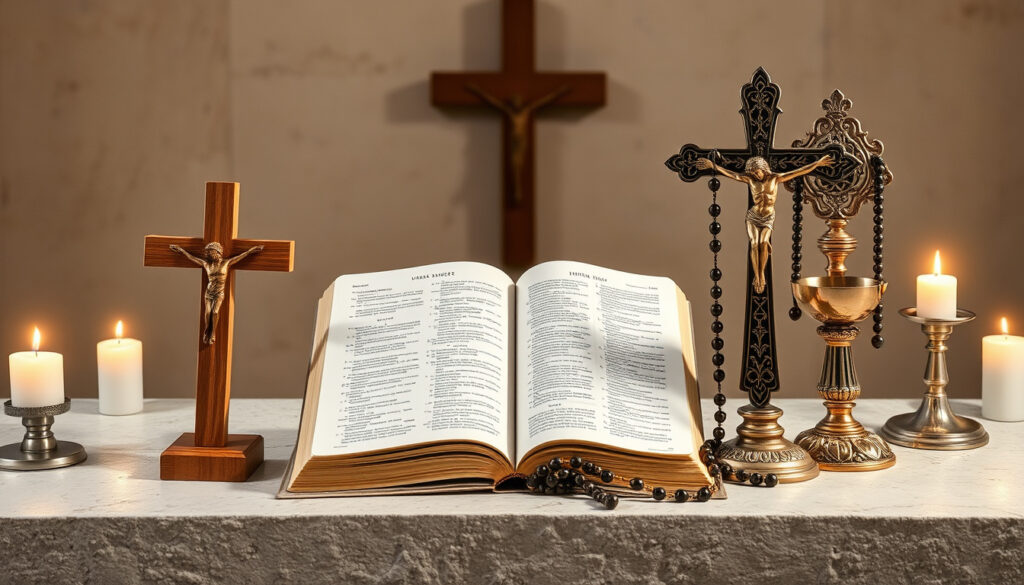
Difference Between Catholic and Christian: Key Comparisons
Catholics are Christians—but the relationship between Catholicism and the broader Christian tradition is more complex than many realize. All 1.3 billion Catholics belong to a 2.4-billion-strong Christian tradition, though not every Christian identifies as Catholic.
Christians worldwide: 2.4 billion ·
Catholics as share: 50% ·
Pope recognition: Catholics only ·
Sacraments: 7 in Catholicism ·
Bible books: 73 Catholic vs 66 Protestant
Quick snapshot
- Catholics are Christians by definition (The Gospel Coalition)
- Catholic Bible contains 73 books vs 66 for Protestants (Text and Canon Institute)
- Catholics recognize 7 sacraments; most Protestants recognize 2 (Grand Canyon University)
- Degree to which individual worship practices vary by denomination within Protestantism
- How regional cultural contexts shape lived experience of these theological differences
- Protestant Reformation begins in 1517 (Text and Canon Institute)
- Council of Trent defines Catholic canon in 1546 and sacraments in 1547 (Text and Canon Institute)
- Continued dialogue between Catholic, Protestant, and Orthodox traditions
- Ecumenical movements seeking common ground while preserving distinct identities
| Fact | Detail |
|---|---|
| Catholic Population | 1.3 billion |
| Christian Total | 2.4 billion |
| Founded | 1st century AD |
| Key Split | 16th century Reformation |
| Bible Books Catholic | 73 |
What is the difference between Christianity and Catholicism?
Catholicism is a branch of Christianity—the religion founded in the 1st century around the life and teachings of Jesus Christ. All Catholics are Christians, but Christianity also encompasses Protestantism, Orthodoxy, and dozens of other traditions. The Catholic Church represents roughly half of all Christians worldwide, making it the single largest Christian denomination.
Core definitions
Christianity is the broader faith tradition centered on Jesus as the Son of God, the salvation he offers, and the Bible as Scripture. Catholicism is one expression of that faith, distinguished by specific doctrines, a hierarchical structure led by the Pope, and a sacramental system that includes seven rites.
Historical origins
The Catholic Church traces its origins directly to the apostles—Peter is traditionally seen as the first Pope. The Reformation in the 16th century led to the emergence of Protestant denominations that rejected papal authority and certain Catholic doctrines. This schism is why Catholicism and Protestantism are now understood as distinct traditions within Christianity.
Authority sources
Catholicism holds that Scripture and Sacred Tradition carry equal authority, with the Magisterium (the Pope and bishops) as the sole authentic interpreter of both. This is codified in the Catholic Catechism, which states that church certainty on revealed truths comes from Scripture and Tradition equally. Protestantism, by contrast, holds to sola scriptura—the Bible alone as the rule of faith. This theological split is central to the Catholic-Protestant divide.
Do Catholics and Christians believe in the same God?
Yes. Catholics and other Christians share the same core confession: belief in one God who exists in three persons—Father, Son, and Holy Spirit (the Trinity). Both traditions affirm that Jesus Christ is the Son of God, fully divine and fully human, who died for humanity’s sins and offers eternal life through resurrection.
Shared Trinity belief
The Nicene Creed, formulated in the 4th century, is recited in Catholic churches and most Protestant denominations alike. It proclaims belief in “one God, the Father Almighty, maker of heaven and earth” and “one Lord, Jesus Christ, the only-begotten Son of God.” This shared creedal foundation means Catholics and Protestants worship the same divine Persons.
Jesus as central figure
Both traditions hold that Jesus is the Messiah, that his death and resurrection bring salvation, and that he will return in glory. Where they diverge is in practices around that core belief—Catholicism emphasizes the saints, Mary, and the sacraments as channels of grace, while most Protestant traditions focus more directly on Scripture and personal faith as the means of receiving Christ.
Do Catholics believe in Jesus?
Absolutely. The Catholic Church affirms the divinity of Christ without reservation. The Catechism of the Catholic Church describes Jesus as “the eternal Son of God, who became incarnate for our salvation.” Jesus is at the center of Catholic worship, theology, and sacramental life.
Jesus as Son of God
Catholic teaching holds that Jesus is the second Person of the Trinity, co-eternal with the Father, who took on human flesh in the Incarnation. This is non-negotiable Catholic doctrine, confirmed repeatedly in ecumenical councils and enshrined in the Catechism.
Role in salvation
Catholicism teaches that Jesus’s death on the cross redeems humanity from sin and that his resurrection is the promise of eternal life. However, Catholics believe that grace flows through the seven sacraments—and that participation in these rites, combined with faith and works, leads to salvation. Many Protestant traditions, by contrast, emphasize salvation by faith alone (sola fide) with the sacraments as secondary.
What is the difference between Catholic and Protestant?
The Catholic-Protestant divide has shaped Western Christianity for five centuries. It began with Martin Luther’s 95 Theses in 1517, which challenged Catholic practices including the sale of indulgences. The resulting Reformation gave birth to Protestantism and set off a theological confrontation that continues to influence both traditions today.
Bible canon
The most visible difference between Catholic and Protestant Bibles is the number of books. Catholic Bibles contain 73 books total—46 in the Old Testament and 27 in the New Testament. Protestant Bibles contain 66 books total—39 in the Old Testament and 27 in the New Testament. The seven additional books in the Catholic Old Testament are called the Deuterocanon; Protestants refer to them as the Apocrypha.
The Catholic Church officially defined its canon at the Council of Trent in 1546, while the Protestant canon follows the Hebrew tradition. Early Protestants rejected the Deuterocanonical books partly because they supported doctrines that Protestant reformers disputed, such as prayers for the dead and the intercession of saints.
Protestants and Catholics share the identical 27 books of the New Testament—the difference is entirely in the Old Testament canon.
Mary and saints
Catholicism venerates Mary as the Mother of God and honors saints as exemplars of Christian virtue who can intercede with God on behalf of the faithful. The doctrine of papal infallibility, defined in 1870, holds that the Pope, speaking ex cathedra, is preserved from error in matters of faith and morals. Protestantism universally rejects both papal authority and the veneration of Mary and saints, viewing them as unsupported by Scripture alone.
What do Catholics believe?
Catholic doctrine is codified in the Catechism of the Catholic Church, a comprehensive text published in 1992 that articulates beliefs on God, creation, salvation, the sacraments, prayer, and morality. The Catechism synthesizes Scripture, Tradition, and papal teaching into a unified theological system.
Key doctrines
Among the core Catholic doctrines that distinguish it from Protestantism:
- Transubstantiation: The bread and wine at Mass become the actual body and blood of Christ, while their outward appearance remains.
- Salvation through sacraments: Grace is conferred through the seven sacraments, which Catholic theology holds Christ implicitly instituted.
- Scripture and Tradition: Both carry equal authority; the Magisterium is the sole authentic interpreter of Scripture.
Precepts and requirements
Catholics are expected to attend Mass on Sundays and holy days, confess sins at least once a year, receive communion at least during the Easter season, contribute to the support of the Church, and observe the laws of fasting. These obligations reflect the sacramental worldview that governs Catholic spiritual life. For those seeking deeper spiritual understanding, the significance of Psalm 121 and its message of protection can be explored at $Salmo 121 significado.
Catholic teaching holds that sacraments confer grace ex opere operato—”from the work worked”—meaning they are effective by virtue of the action itself, independent of the recipient’s moral disposition. The Council of Trent affirmed this in 1547 against Protestant claims that faith alone was sufficient.
| Area | Catholic | Protestant |
|---|---|---|
| Bible canon | 73 books (46 OT including Deuterocanon) | 66 books (39 OT, Hebrew canon) |
| Sacraments | 7 (baptism, Eucharist, confirmation, reconciliation, anointing, marriage, orders) | 2 typically (baptism, Lord’s Supper) |
| Scripture authority | Scripture + Tradition + Magisterium | Sola scriptura (Bible alone) |
| Pope | Vicar of Christ; infallible on doctrine | Rejected; no universal authority figure |
| Confession | Priest acts in Christ’s authority (John 20:23) | Direct to God; priestly absolution rejected |
| Mary and saints | Venerated; can intercede | Not venerated; no intercession of saints |
The pattern reveals that Catholics and Protestants diverge most sharply on authority structures—the Pope, sacred Tradition, and the role of the Magisterium—while remaining aligned on core Christological doctrines.
Related reading: Four Horsemen of the Apocalypse
eden.co.uk, united-church.ca, gracebc.ca, shop.catholic.com, usccb.org, modernreformation.org, youtube.com, youtube.com
Frequently asked questions
Is Catholic and Christian two different religions?
No. Catholicism is a branch of Christianity. All Catholics are Christians, but Christianity also includes Protestantism, Orthodoxy, and other traditions. The confusion arises because “Christian” is often used narrowly to mean “not Catholic,” when in fact the relationship is the opposite.
What is the biggest difference between Catholic and Christian?
The biggest structural difference is papal authority. Catholics recognize the Pope as the successor of Peter and the head of the Church; most other Christians do not. This single difference shapes many others, including how Scripture is interpreted, how Tradition functions, and whether the sacraments are seven or two.
What is the difference between Catholic and Christian Bible?
Catholic Bibles contain 73 books; Protestant Bibles contain 66. The difference lies in the Old Testament, where Catholic Bibles include seven Deuterocanonical books (Tobit, Judith, Wisdom of Solomon, Sirach/Ecclesiasticus, 1-2 Maccabees, Baruch) and additions to Daniel and Esther. Both share the identical 27 books of the New Testament.
How old is Catholicism vs Christianity?
Catholicism and Christianity are the same age—Catholicism IS Christianity, rooted in the 1st-century Church founded by the apostles. The Catholic Church as an institution traces directly to this origin. The Reformation in the 16th century (1517 onward) produced Protestantism as a distinct tradition, so Protestantism is roughly 500 years old.
What are the 5 requirements for Catholics?
The Catholic Church teaches Five Precepts (not requirements in the legal sense): attend Mass on Sundays and holy days, confess sins at least annually, receive communion at least during Easter, contribute to the Church’s support, and observe the laws of fasting and abstinence.
What is not allowed for Catholics?
Catholic doctrine prohibits acts deemed mortal sins (including murder, adultery, and apostasy), contraception without Church approval, abortion, ordination of women, and marriage outside the Church without a dispensation. These prohibitions are grounded in natural law and Scripture as interpreted by the Magisterium.
What are the 4 types of religion?
Christianity broadly is divided into three main branches: Catholic, Protestant, and Orthodox. These reflect historical divisions—not theological tiers. Catholicism (led by the Pope), Orthodoxy (led by patriarchs), and Protestantism (characterized by sola scriptura and the rejection of papal authority) together form the three major Christian families.
“Both Scripture and Tradition must be accepted and honoured with equal sentiments of devotion and reverence.”
Catholic Catechism, #82
“The task of interpreting the Word of God authentically has been entrusted solely to the Magisterium of the Church, that is, to the Pope and to the bishops.”
Catholic Catechism, #100
“If anyone shall say that by the said sacraments of the New Law, grace is not conferred from the work which has been worked [ex opere operato], but that faith alone is sufficient, let him be anathema.”
Council of Trent, seventh session, 1547
The relationship between Catholic and Protestant Christianity is not one of opposition but of branching. When you understand that 1.3 billion Catholics are part of a 2.4-billion-strong Christian tradition, the theological differences become a matter of internal family debate rather than interfaith division. For anyone exploring these questions—whether for personal faith, academic curiosity, or interfaith dialogue—the starting point is clarity on what all Christians share: belief in Jesus as Lord, the resurrection, and the God who made heaven and earth.
More related posts
 Fred Again: Biography, Nepo Baby Rumors & Rise to Fame
 Charlotte Tilbury Contour Wand: Honest Review & Shade Guide
 How to Detect Language to English on Google Translate
 Jay Kay: Net Worth, Biography, Relationships, and Career
 Saint Gobain Share Price: Chart, Dividend & Targets
 Dermot Kennedy: Real Name, Songs, Height, and Relationship
 Colin Salmon: Biography, Height, Ethnicity, and EastEnders Role
 How to Get Super Glue Off Skin: Safe and Fast Methods