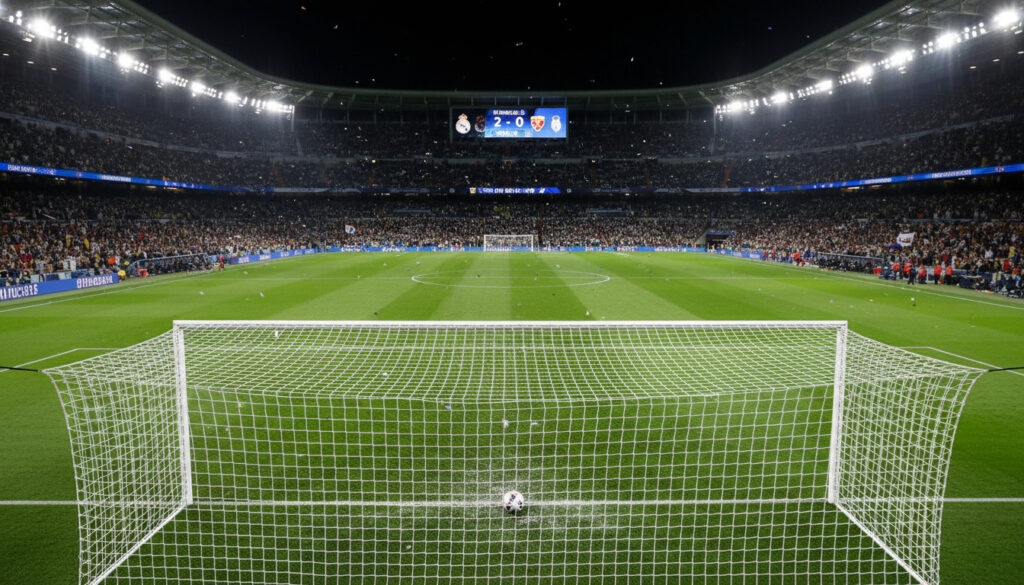
Real Madrid vs Dortmund – 2-0 Final Result and Key Moments
Real Madrid defeated Borussia Dortmund 2-0 in the 2024 UEFA Champions League final on June 1, 2024, at London’s Wembley Stadium, securing a record-extending 15th European title. The Spanish side struck twice in the final sixteen minutes through Dani Carvajal and Vinícius Júnior after the German club had dominated the opening period without converting their chances.
The match attracted 86,212 spectators to the English capital, with Slovenian referee Slavko Vinčić officiating the contest. While Dortmund created superior opportunities before the interval, Madrid’s efficiency and defensive resilience proved decisive in what was the first final meeting between the two clubs in European competition history.
This analysis examines the tactical patterns, decisive moments, and historical significance of the encounter based on official match data and post-match reports.
Who Won Real Madrid vs Dortmund and What Was the Final Score?
Real Madrid’s victory extended their unprecedented dominance in European football, marking their 15th triumph in the competition. The result denied Dortmund a second European crown, with the club’s last success occurring 27 years prior.
- The victory represents Real Madrid’s sixth Champions League title in the last eleven seasons
- Dortmund failed to convert any of their four shots on target despite first-half superiority
- Dani Carvajal scored the decisive opening goal from a set-piece situation
- Toni Kroos concluded his club career with a record-equaling sixth winners’ medal
- Attendance of 86,212 marked one of the largest crowds in recent final history
- The clean sheet marked Courtois’s third consecutive final without conceding
| Statistic | Borussia Dortmund | Real Madrid |
|---|---|---|
| Final Score | 0 | 2 |
| Possession | 42.7% | 57.3% |
| Total Shots | 13 | 13 |
| Shots on Target | 4 | 6 |
| Corner Kicks | 9 | 8 |
| Yellow Cards | 3 | 1 |
| Goalkeeper Saves | 4 | 3 |
Data from ESPN match statistics.
What Were the Key Moments and Goals in the UCL Final?
Dortmund’s First-Half Dominance
Borussia Dortmund controlled the opening exchanges, registering multiple chances against the Spanish side’s defense. Karim Adeyemi and Niclas Füllkrug both came close to opening the scoring, with Füllkrug striking the woodwork during the period of German pressure. Despite their territorial advantage and high pressing, the side entered the interval scoreless, a failure that proved decisive to the final outcome.
Carvajal’s Decisive Breakthrough
The breakthrough arrived in the 74th minute when Dani Carvajal rose above the defense to head home from a Toni Kroos corner kick. The goal came against the immediate run of play, which had seen Madrid gradually assert control after the hour mark. Carvajal’s finish broke the deadlock and shifted the momentum irreversibly toward the Spanish side.
Toni Kroos’s delivery for the opening goal represented his final assist in a Real Madrid shirt, concluding his club career with a decisive contribution in his fourth Champions League final victory.
Vinícius Seals the Triumph
Nine minutes later, Vinícius Júnior extinguished German hopes with a clinical finish in the 83rd minute. Following an interception of a pass from Dortmund’s Ian Maatsen, Jude Bellingham fed the Brazilian forward who calmly slotted past goalkeeper Gregor Kobel. The strike confirmed Madrid’s triumph before the final whistle.
Extended video highlights are available via official UEFA footage.
What Were the Lineups and Key Stats for Real Madrid vs Dortmund?
Borussia Dortmund Starting XI
Coach Edin Terzić deployed his side in a 4-2-3-1 formation. Gregor Kobel started in goal, protected by a back four of Ian Maatsen, Nico Schlotterbeck, Mats Hummels, and Julian Ryerson. Emre Can and Marcel Sabitzer formed the double pivot, with Julian Brandt in the attacking midfield role. Karim Adeyemi and Jadon Sancho operated on the flanks, supporting central striker Niclas Füllkrug. No substitutions occurred at half-time.
Real Madrid Starting XI
Carlo Ancelotti’s side utilized a flexible 4-3-3 system. Thibaut Courtois returned between the posts, with Dani Carvajal, Éder Militão, and Antonio Rüdiger forming the defensive core. Toni Kroos, Federico Valverde, and Jude Bellingham controlled midfield, while Vinícius Júnior led the attack. In the 79th minute, Luka Modrić and Joselu replaced Bellingham and Kroos to secure the result.
Despite Dortmund creating an equal number of total shots (13), Real Madrid directed six efforts on target compared to Dortmund’s four, demonstrating superior accuracy in the attacking third.
Statistical Analysis
The possession statistics reflected Madrid’s gradual control of the midfield as the match progressed, ending at 57.3% to 42.7%. However, the quality of chances created by Dortmund in the opening period generated significant pressure that required crucial defensive interventions from Antonio Rüdiger and decisive saves from Courtois to maintain the clean sheet.
Complete tactical analysis available via WhoScored match data.
What Is the Head-to-Head Record Between Real Madrid and Dortmund?
Prior to the Wembley final, the two clubs had met 14 times in European competition. Real Madrid held the advantage with six victories to Dortmund’s three, with five matches ending in draws. Their most recent encounters occurred during the 2017-18 group stage, when Madrid secured a 3-1 away victory followed by a 3-2 home win.
A subsequent Champions League meeting in October 2024 resulted in a 5-2 victory for Real Madrid at the Santiago Bernabéu. This fixture occurred during the 2024-25 league phase and is statistically separate from the June final. For a detailed look at their previous encounters, including a 2-1 victory for Real Madrid against Celta Vigo, Real Madrid vs Celta Vigo.
The 2024 final represented their first meeting in a European Cup final, despite both clubs’ extensive histories in the competition. Dortmund’s path to the final included a 2-0 aggregate semi-final victory over Paris Saint-Germain, while Madrid defeated Bayern Munich 4-3 on aggregate to reach Wembley.
Historical data from UEFA Champions League archives.
What Was the Exact Sequence of Decisive Events?
- : Kick-off at Wembley Stadium with 86,212 spectators present
- : Toni Kroos delivers free kick; Carvajal heads over the crossbar
- : Goal – Carvajal heads in from Kroos corner to give Real Madrid 1-0 lead
- : Double substitution for Madrid: Joselu and Modrić replace Bellingham and Kroos
- : Goal – Vinícius Júnior finishes from Bellingham pass to make it 2-0
- : Full time; Real Madrid crowned champions
Match timeline details per the UEFA official match report.
What Information Is Definitively Established?
| Verified Facts | Unconfirmed or Uncertain Details |
|---|---|
| Final score 2-0, goalscorers Carvajal (74′) and Vinícius (83′) | Specific post-match transfer negotiations involving either club |
| Attendance: 86,212 (official UEFA figure) | Exact broadcast viewership figures for all global territories |
| Referee: Slavko Vinčić (Slovenia) | Long-term managerial decisions following the result |
| Toni Kroos’s final club appearance confirmed | Impact of the defeat on Dortmund’s summer recruitment budget |
| Real Madrid’s 15th European Cup title | Aggregate player ratings consistency across different media outlets |
What Is the Historical Significance of This Victory?
Real Madrid’s triumph extended their record as the most successful club in European Cup history. The victory maintained Madrid’s perfect record in Champions League finals since 1981, reinforcing their status as the competition’s dominant force. For Toni Kroos, the final represented a fitting conclusion to a decade at the club, earning his sixth winners’ medal.
The result continued Dortmund’s wait for a second European crown, despite a campaign that saw them eliminate Atlético Madrid and Paris Saint-Germain against expectations. As champions, Real Madrid qualified for the 2024 UEFA Super Cup against Atalanta and the FIFA Intercontinental Cup.
Further sporting calendars are available including the Grand Prix Calendar 2025.
Additional context from BBC Sport archives.
What Do Official Sources and Analysis Say?
Dortmund created more chances early but failed to convert, with Real Madrid efficient late.
— Match analysis consensus from ESPN and WhoScored data
Fan commentary from statistical aggregators noted that Dortmund “ought to be 2-0 up at halftime” given the quality of chances created by Adeyemi and Füllkrug. UEFA’s official match documentation highlighted the defensive interventions from Madrid’s backline as crucial to maintaining parity before the late offensive strikes.
Summary of the 2024 Champions League Final
Real Madrid defeated Borussia Dortmund 2-0 at Wembley Stadium on June 1, 2024, to win their 15th European Cup title. Despite Dortmund’s first-half superiority and multiple clear chances, goals from Dani Carvajal and Vinícius Júnior in the 74th and 83rd minutes secured victory for the Spanish side. The result extended Madrid’s dominance in the competition while confirming their status as Europe’s preeminent club. For additional match analysis, see our coverage of Sheffield Wednesday vs Leeds United.
Frequently Asked Questions
Who officiated the 2024 Champions League final?
Slovenian referee Slavko Vinčić officiated the match, issuing three yellow cards to Dortmund and one to Real Madrid.
What was the half-time score?
The match remained 0-0 at half-time despite Dortmund creating several clear scoring opportunities.
Which players were substituted late in the match?
Real Madrid replaced Jude Bellingham and Toni Kroos with Joselu and Luka Modrić between the 79th and 80th minutes.
Where can I watch extended highlights?
Official extended highlights are available via UEFA’s YouTube channel and ESPN’s match coverage.
How many shots did each team attempt?
Both teams attempted 13 shots total, though Real Madrid registered six on target compared to Dortmund’s four.
What trophy did the winners qualify for?
Real Madrid qualified for the 2024 UEFA Super Cup against Atalanta and the FIFA Intercontinental Cup.
Was this the first meeting between these teams in a final?
Yes, this was their first Champions League final meeting, though they had played 14 times previously in group and knockout stages.
More related posts
 Candy Brothers: Wealth, Marriages, and Political Ties
 Intensive Driving Course Near Me: Ireland Fast-Track Guide
 Meryl Streep: Tragedy, Marriage Separation, and Net Worth
 Nico Parker: Ethnicity, Parents, Career & Facts
 Erin Kellyman: Age, Height, Ethnicity, Roles & More
 Federico Chiesa: Stats, Partner, Transfer & Career 2026
 Jack O’Connell Movies and TV Shows – Complete Filmography and Rankings
 Too Good To Go App Review: How It Works and Is It Worth It