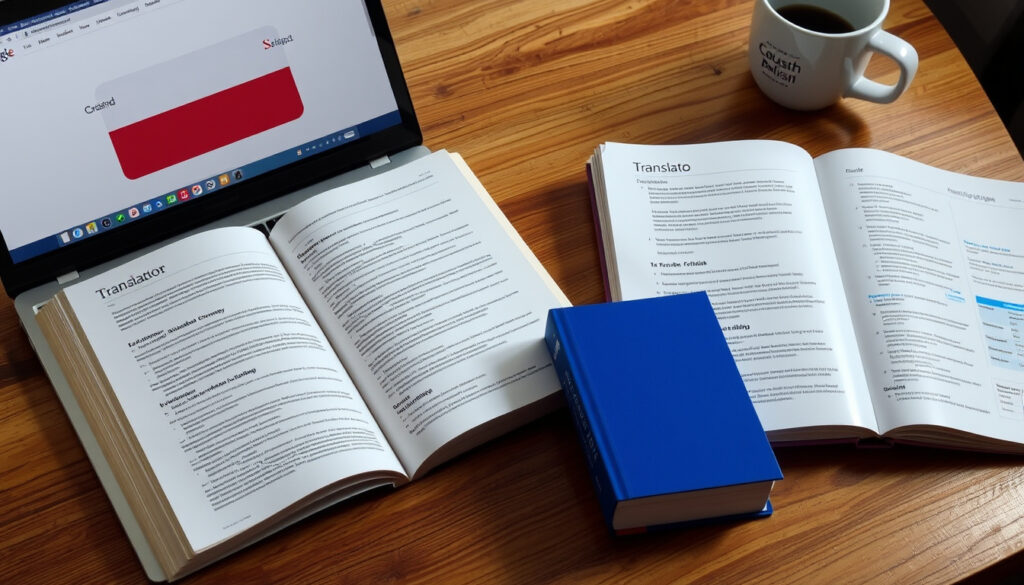
Google Translate English to Polish: Accuracy Guide & Tips
Anyone who has tried to translate a Polish sentence word-for-word knows how quickly things can go wrong. Google Translate is the go‑to tool for millions, but the results for English‑to‑Polish can be surprisingly hit‑or‑miss – and we’ll walk through the service’s real‑world accuracy, its quirks with Polish grammar, and the smartest ways to check its output so you don’t end up with a literal – and wrong – translation.
Languages supported by Google Translate: 108 (text), 249 (app) ·
Daily translations processed by Google: Over 100 billion words ·
Polish‑English translation accuracy (high‑level): Estimated 85‑90% for simple sentences ·
Number of Google Translate app downloads: Over 1 billion (Android)
Quick snapshot
- Google Translate is a free service provided by Google (Google Translate Official Site)
- The exact accuracy percentage for English‑to‑Polish translation in 2025 lacks a single peer‑reviewed study
- Whether Google Translate handles all seven Polish grammatical cases correctly in every context remains unverified
- 2006: Google Translate launches with limited languages (Phrase Blog (industry analysis))
- 2016: Switch to Neural Machine Translation dramatically improves accuracy for Polish (Phrase Blog (industry analysis))
- Ongoing updates continue to improve handling of Polish grammar cases and verb aspects, though gaps remain
The table below summarizes key facts about Google Translate and Polish.
| Label | Value |
|---|---|
| Main service URL | translate.google.com |
| English‑to‑Polish equivalent of James | Jakub |
| Polish letter “ł” pronunciation | Similar to English “w” |
| Meaning of Polish word “dupa” | Buttocks (slang) |
| Number of Polish language speakers worldwide | Approximately 45 million |
Is Google Translate accurate for Polish?
Factors that affect translation accuracy
Google Translate’s accuracy for English‑to‑Polish is estimated at 85–90% for simple, straightforward sentences. However, that number drops sharply with longer or idiom‑heavy text. According to a 2021 UCLA study cited by Phrase Blog (localization industry analyst), the tool preserved general meaning in 82.5% of translations across all languages – but Polish, with its seven grammatical cases and complex verb aspects, often falls below that average when the input isn’t controlled.
Common errors in Polish translations
- Idioms get translated literally, altering the intended meaning (CapCut Resource Guide (practical translation tips))
- Context‑dependent words like dupa can be mistranslated without surrounding clues
- Long sentences lose grammatical flow because the tool struggles with case agreement across many words
The implication: short, clear input is key to getting usable Polish output from the tool.
How accurate is Google Translate overall?
Recent studies on translation tool accuracy
A round of research from 2011 to 2019 shows a 34% improvement in Google Translate’s overall accuracy, driven largely by the shift to neural machine translation (NMT) and the Transformer model introduced in 2018 (Phrase Blog (industry analysis)). Yet the service still ranges from 55% to 94% accuracy depending on the language pair and content type. Polish, in a 2011 study, ranked 7th out of 10 European languages – a mid‑tier performance that has likely improved but still lags behind languages like Spanish or French.
Comparison with professional human translation
Professional human translators consistently outperform machine tools for Polish because they understand pragmatics – the implied meaning that changes with word order and case. Google’s NMT is excellent at pattern recognition but cannot always choose the correct case for a noun in a subordinate clause. As Translate.com (human + machine translation platform) notes, human review remains the gold standard for legal or literary Polish text.
For everyday English‑to‑Polish needs, Google Translate saves time – but anyone sending an important Polish email or translating a contract should budget for a human proofread.
The pattern: machine translation is a productivity tool, not a substitute for native‑level Polish understanding.
What is the Polish name for James?
Common Polish equivalents for English names
Many English names have well‑established Polish counterparts. The Polish equivalent of James is Jakub. Similarly, John becomes Jan, George becomes Jerzy, and Catherine becomes Katarzyna. Google Translate correctly converts these when the name is typed in a complete sentence, but users should double‑check if the name appears in isolation – the tool may sometimes default to the English spelling.
Polish naming conventions
Polish uses a patronymic‑like system? No, but surnames often take different endings for men and women (e.g., Kowalski vs. Kowalska). Google Translate generally preserves the form it receives, so if you input the English name “James” it will output “Jakub” – provided the context makes clear it’s a name and not the verb “jam.”
What does “ł” mean in Polish?
Pronunciation of the Polish letter Ł
The letter ł (lowercase) or Ł (uppercase) is a distinct character in the Polish alphabet. Its pronunciation is similar to the English “w” – so the word łódka (boat) sounds like “wood‑ka.” As Wikipedia (general reference) explains, it originated as a velarised L but evolved into a labiovelar semivowel. Google Translate pronounces ł correctly in its audio feature, but users who type the Polish letter using the standard Latin “l” will get a different, incorrect sound.
How “ł” appears in common Polish words
- łaska – grace (pronounced “was‑ka”)
- głowa – head
- długi – long
When translating from English to Polish, Google Translate correctly inserts ł in words that require it – but only if the word is in its dictionary. Uncommon proper nouns may be left with a plain “l.”
Is the word “dupa” Polish?
Common Polish slang words
Yes, dupa is a common Polish slang word meaning “buttocks” or “ass.” It appears in everyday conversation and in many idioms, such as mieć dupę (to be lucky, literally “to have a butt”). Google Translate usually renders it as “ass” or “butt,” which is context‑dependent. Without clarifying text, the tool may miss the idiomatic meaning and give a literal translation.
Potential mistranslation pitfalls
Because dupa is both a crude term and a playful one depending on context, Google Translate can’t always choose the right register. A sentence like On ma dupę could mean “He has an ass” or, idiomatically, “He’s lucky.” The tool will likely pick the literal translation, so users should be aware of this when translating casual Polish text.
Slang and idiomatic phrases are the weakest point for Google Translate in Polish. If you’re translating a casual conversation, expect the tool to miss the nuance – and use a slang‑aware dictionary as a backup.
What this means: context‑aware verification is essential for Polish slang translations.
How to Translate English to Polish Using Google Translate
- Go to translate.google.com (Google Translate) or open the Google Translate app.
- Select English as the source language and Polish as the target language.
- Type or paste your text. For voice translation, tap the microphone icon and speak clearly (Google Play – Google Translate (app features)).
- Review the output. For important messages, paste the Polish back into Google Translate set to Polish‑to‑English to check consistency.
- Use the speaker icon to hear the pronunciation – especially useful for mastering sounds like ł and ą.
The catch: while the steps are simple, the quality of the output depends heavily on how clean your English input is. Short sentences with clear subjects produce the best Polish translation. For a deeper dive into Google Translate’s capabilities with Polish, explore Arielle Kebbel movies and TV shows.
What’s clear and what isn’t
Confirmed facts
- Google Translate is a free service provided by Google (Google Translate Official Site)
- The Polish name for James is Jakub
- The letter “ł” in Polish is pronounced like English “w” (Wikipedia (general reference))
- Google Translate supports photo and handwriting translation for Polish (Google Play – Google Translate (app details))
- Accuracy improved dramatically after switching to neural machine translation in 2016 (Phrase Blog (industry analysis))
What’s unclear
- The exact accuracy percentage for English‑to‑Polish translation in 2025 has no single peer‑reviewed study
- Whether Google Translate handles all Polish grammatical cases correctly in every context remains unverified
- How well the tool performs on Polish legal or medical texts specifically
The catch: Published data on Polish‑specific accuracy remains thin, making user‑side verification the only reliable check.
Perspectives from experts
“The letter Ł is a distinct character in the Polish alphabet, representing a sound similar to the English ‘w’. It originated as a velarized L but evolved into a labiovelar semivowel.”
“Google Translate preserved general meaning in 82.5% of translations across languages, according to a 2021 UCLA study. For Polish, the accuracy was median among European languages in earlier tests.”
Phrase Blog (localization industry analysis)
“Avoid idioms in Polish text as Google Translate often translates them literally, altering meaning. Short sentences in Polish enhance translation accuracy.”
Google Translate is an effective starting point for English‑to‑Polish translation, especially for short, clear sentences. But its weaknesses with Polish grammar, idioms, and contextual slang mean that anyone relying on it for professional or personal communication should verify the output with a dedicated Polish dictionary or a native speaker. For the millions of Polish speakers worldwide, the tool is a helper – not a replacement for understanding the language’s rich case system.
For more translation guides, check out our resources: Translate English to Tamil and English to Hindi Translation.
Frequently asked questions
How do I use Google Translate for English to Polish on my phone?
Download the Google Translate app from the Google Play Store or Apple App Store. Open the app, set source to English and target to Polish, then type or speak your text. The app also supports camera translation for signs and menus.
Is there a way to translate voice from English to Polish on Google Translate?
Yes – tap the microphone icon and speak clearly. Google Translate will automatically convert your speech to text and then to Polish. Real‑time conversation translation is also available in 70 languages (Google Play – Google Translate (app features)).
Can Google Translate handle Polish grammar correctly?
It handles basic grammar well, but for complex sentences involving multiple cases, verb aspects, or gender‑based endings, errors are common. Always proofread important Polish translations.
Does Google Translate work offline for Polish?
Yes, but you need to download the Polish language pack for offline use in the app. The offline version is less accurate than the online neural engine.
What is the best alternative to Google Translate for English to Polish?
Translate.com (human + machine translation platform) offers both machine and human translation options. For dictionary‑focused checking, consider PONS or Cambridge Polish–English.
How do I translate a Polish word back to English using Google Translate?
Simply swap the language selection: set source to Polish and target to English, then type the Polish word. Use the auto‑detect feature if you’re unsure.
More related posts
 Dolly Parton FAQ: Health, Wealth, Marriage, and Rumors
 Jack O’Connell Movies and TV Shows – Complete Filmography and Rankings
 Sergio Ramos in 2026: Free Agent, Spain Exit, Messi Friendship
 Saint Gobain Share Price: Chart, Dividend & Targets
 Why Is Rapeseed Oil Bad for You? Myths vs Modern Science
 Premier African Minerals Share Price: Forecast & Risks
 Bethany Joy Lenz: Cult, Net Worth, Family & Book 2025
 Derren Litten: Benidorm Creator, Current Work & More