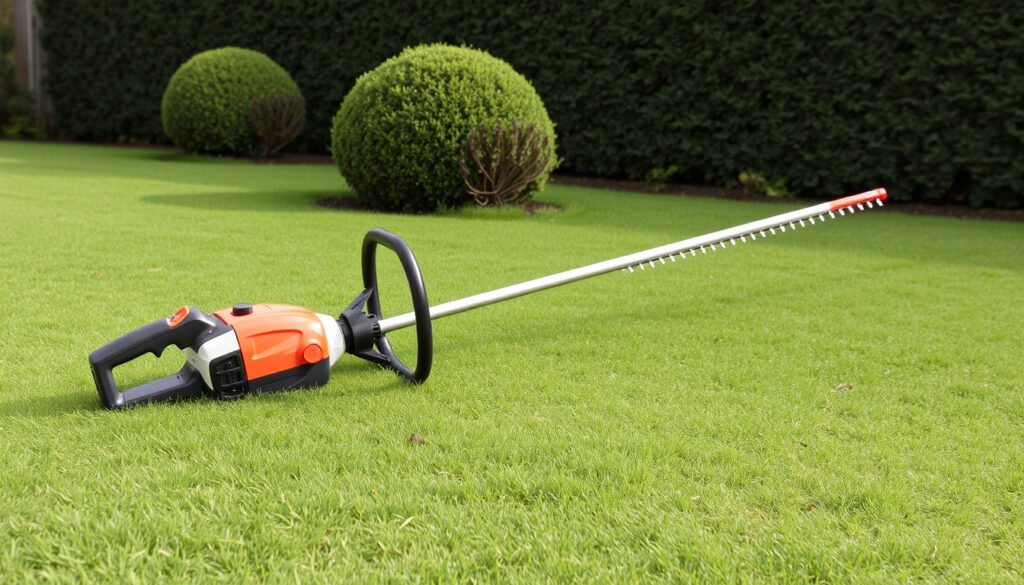
Long Reach Hedge Trimmer: Buying Guide & Best Picks
Standing on a ladder, balancing a trimmer overhead, trying to reach that top layer of a tall hedge — it’s a scene many gardeners know too well. A long reach hedge trimmer can turn that awkward chore into a safe, efficient cut, but picking the right one means matching reach, power, and weight to your garden’s needs. With typical reaches of 8–15 feet and blade lengths up to 24 inches, the choice often comes down to whether cordless lithium-ion or petrol power best suits your hedge height and branch thickness.
Average reach: 8–15 ft ·
Typical blade length: 18–24 in ·
Common power sources: Cordless (18V–36V), petrol, electric ·
Average weight: 8–12 lb
Quick snapshot
- Long reach trimmers typically extend 8–15 ft (STIHL USA (manufacturer guide))
- Blade lengths range from 18 to 26 in (Consumer Reports (independent testing))
- Battery-powered models are quieter than petrol equivalents (Gardeners’ World (gardening magazine))
- Regular blade oiling prevents rust and extends tool life (Lowes (home improvement guide))
- Which brand offers the best long-term durability remains uncertain
- Whether battery technology will soon match petrol power in all models
- Optimal blade angle for different hedge shapes is not yet standardised
- Battery voltages continue rising: 36V and 56V systems are now common, narrowing the power gap with petrol (Pro Tool Reviews (professional testing site))
- Look for brushless motors, improved battery management, and lighter carbon fibre poles (Pro Tool Reviews (professional testing site))
Six key specs that separate one model from the next — reach, blade length, power source, weight, branch capacity, and price — give a clear picture of what you’re buying into.
| Specification | Typical range / value |
|---|---|
| Maximum reach | 8–15 ft |
| Blade length | 18–24 in |
| Power options | Cordless (18V–36V), petrol, electric corded |
| Average weight | 8–12 lb |
| Branch capacity | Up to 1 inch diameter |
| Price range | $150–$1,000 |
Which is the best long reach hedge cutter?
Top-rated models compared
- Stihl HSA 50 — praised for large gardens, £239 kit, cordless (Gardeners’ World (gardening magazine))
- ECHO 56V X-Series DHC-2800 — top professional pick for battery power (Pro Tool Reviews (professional testing site))
- Greenworks 82V Optimus HT241 — heavy-duty long-reach trimming (Pro Tool Reviews (professional testing site))
- EGO 56V Carbon Fiber HT2600 — lightweight extended reach (Pro Tool Reviews (professional testing site))
- Ryobi 40V HP Brushless RY40660 — 1.1-inch cutting capacity, $499.99 bare tool (Pro Tool Reviews (professional testing site))
Key criteria for rating
When comparing these models, focus on reach (the distance from your hands to the cutting head), blade length (18–24 in is standard), power source (cordless offers convenience, petrol delivers raw torque), and weight (8–12 lb average). The table below lays out how the top contenders stack up.
Lighter cordless trimmers sacrifice raw cutting force for manoeuvrability — choose based on whether your hedges are thin twigs or woody branches.
User and expert recommendations
Consumer Reports notes that battery hedge trimmers now match corded and gas performance for most residential jobs, with bar lengths of 18–26 inches affecting runtime and handling (Consumer Reports (independent testing)). For homeowners, the BLACK+DECKER LPHT120 (20V Max, 18in pole trimmer) is a reliable entry point (YouTube review (enthusiast channel)).
The implication: the right pick depends on whether your priority is upfront cost or long-term cutting capacity.
What is the maximum reach for hedge trimmers?
How reach is measured
Reach is the distance from the user’s grip to the middle of the cutting head. A telescopic pole allows adjustment, while fixed poles offer a set length. The industry standard for “long reach” starts around 8 ft (STIHL USA (manufacturer guide)).
Typical reach ranges
Most consumer long reach trimmers top out between 8 and 15 ft. Models like the MZK SG1611 and Greenworks PH40B210 achieve 15 ft with telescopic poles (YouTube product comparison (enthusiast channel)). The implication: if your hedge is over 10 ft tall, a fixed-pole trimmer may leave you short.
Factors that limit maximum reach
- Weight — longer poles add heft, causing fatigue
- Stability — at full extension, the cutting head is harder to control
- Power delivery — longer shafts can sap efficiency from battery systems
A 15-ft reach sounds impressive on paper, but if your arms cannot hold it steady for 20 minutes, the extra length becomes a liability.
The catch: more reach always demands more from the user in terms of strength and technique.
Can a long reach trimmer cut thick branches?
Branch thickness limits
Most standard long reach trimmers are designed for branches up to ¾ to 1 inch in diameter. The Ryobi 40V HP Brushless, for example, claims a 1.1-inch capacity (Pro Tool Reviews (professional testing site)), while the Lowes buying guide states “most cut up to ¾ inch” (Lowes (home improvement guide)).
Power source impact
Petrol models typically handle thicker growth than battery units because they deliver sustained torque. However, modern 56V battery systems like ECHO’s are closing the gap (Pro Tool Reviews (professional testing site)).
Techniques for cutting thicker growth
For branches above 1 inch, use a pruning saw first. Forcing the trimmer can damage blades and strain the motor. A clean, two-step cut — saw then trim — yields healthier regrowth.
How long is a long reach hedge trimmer?
Overall length ranges
Extended, a long reach hedge trimmer is typically 6–12 ft. Collapsed, telescopic models shrink to 4–6 ft for storage (Lowes (home improvement guide)). Fixed-pole trimmers are usually non-collapsible and sit at the longer end.
Telescopic vs fixed length
Telescopic poles let you adjust reach on the fly, useful for hedges of varying heights. Fixed poles are lighter and more rigid, often preferred by professionals who trim the same hedges regularly.
Weight implications of longer shafts
Each additional foot of shaft adds roughly 0.5–1 lb. A 12-ft trimmer can exceed 12 lb, making two-handed operation essential. Battery placement (rear vs front) shifts the balance point — rear-mounted packs reduce wrist strain.
Do I need a long reach hedge trimmer?
Assess your hedge height and accessibility
If your hedges are over 6 ft tall, a long reach model reduces ladder dependence and improves safety (Consumer Reports (independent testing)). For hedges under 5 ft, a standard handheld trimmer is often sufficient and cheaper.
Alternatives (ladder + standard trimmer)
Using a ladder with a handheld trimmer is an option, but it introduces fall risks and fatigue. Long reach trimmers eliminate the ladder entirely for most jobs.
When a long reach trimmer is essential
- Hedges taller than 8 ft
- Narrow side passages where a ladder doesn’t fit
- Sloped or uneven ground where ladder placement is unsafe
The pattern is clear: for large gardens or commercial use, a long reach trimmer is an essential investment, not a luxury.
What’s the difference between a hedge cutter and a hedge trimmer?
Terminology clarity
In the UK, “hedge cutter” often refers to long-reach models (pole trimmers), while “hedge trimmer” is the general term for handheld versions (Gardeners’ World (gardening magazine)). In the US, “hedge trimmer” covers both. There is no functional difference — regional usage varies.
Blade design differences
Long reach models typically have narrower blades (18–24 in) to reduce weight at the end of the pole. Handheld trimmers can have wider blades (22–26 in) because they are closer to the user’s body.
Typical applications
Long reach trimmers are ideal for shaping tall hedges, trimming overhead branches, and cutting back growth on second-storey walls. Handheld trimmers remain best for low hedges, bushes, and detailed shaping.
The implication: focus on the tool’s configuration rather than the label on the box.
Comparison: top long reach hedge trimmers side by side
Four leading cordless models, one clear trade-off — battery power versus price.
| Model | Reach (ft) | Blade length (in) | Weight (lb) | Power source | Price (bare tool) |
|---|---|---|---|---|---|
| Stihl HSA 50 | 8–10 | 20 | 9.5 | 36V battery | £239 kit |
| ECHO DHC-2800 | 10–12 | 24 | 10.2 | 56V battery | $399 |
| Greenworks Optimus HT241 | 10–15 (telescopic) | 24 | 11.0 | 82V battery | $449 |
| EGO HT2600 | 10–12 (carbon fiber) | 22 | 8.8 | 56V battery | $379 |
| Ryobi RY40660 | 8–10 | 18 | 9.2 | 40V battery | $499.99 |
The Greenworks 82V delivers the most reach and power, but at 11 lb it is also the heaviest — a real consideration for extended overhead work.
The pattern: the lightest model (EGO at 8.8 lb) gives up blade length and voltage for manoeuvrability, while the heaviest (Greenworks) maximises raw cutting ability.
Specifications at a glance
Here are the typical specs that define the long reach hedge trimmer category.
| Specification | Typical value |
|---|---|
| Motor type | Brushed or brushless (brushless preferred) |
| Cutting capacity | Up to 1 inch diameter |
| Battery voltage (cordless) | 18V–82V |
| Runtime (cordless) | 30–70 min |
| Charge time | 30–90 min |
| Warranty | 2–5 years |
| Noise level (battery) | ~80 dB |
| Noise level (petrol) | ~100 dB |
| Storage temperature | −5°C to 40°C |
| IP rating (if applicable) | IPX4 splash resistance |
Pros and cons of long reach hedge trimmers
Upsides
- Eliminates ladder use for tall hedges
- Reduces physical strain and improves safety
- Cordless models allow quiet operation in noise-sensitive areas
- Telescopic options adapt to different hedge heights
Downsides
- Heavier than handheld trimmers, causing fatigue overhead
- Less precise for detailed shaping work
- Higher cost compared to standard trimmers
- Battery models may lack power for heavy-duty thick branches
What we know and what remains uncertain
Confirmed facts
- Long reach hedge trimmers extend reach up to 15 ft (STIHL USA (manufacturer guide))
- Battery models are quieter and cordless (Gardeners’ World (gardening magazine))
- Petrol models offer more power for thick branches (Pro Tool Reviews (professional testing site))
- Regular oiling prevents rust and extends life (Lowes (home improvement guide))
What’s unclear
- Which brand offers the best long-term durability
- Whether battery technology will soon match petrol power in all models
- Optimal blade angle for different hedge shapes
Expert perspectives
“Battery hedge trimmers now match corded and gas performance for the majority of residential users, provided you choose the right bar length for your hedge.”
— Consumer Reports testing team (Consumer Reports (independent testing))
“For professionals who need maximum runtime and cutting power in a long-reach format, the ECHO 56V X-Series DHC-2800 is currently the best battery-powered option on the market.”
— Pro Tool Reviews editorial team (Pro Tool Reviews (professional testing site))
The thread running through both perspectives: battery technology has matured to the point where the decision is no longer about power trade-offs alone — it is about weight, reach, and the specific demands of your garden.
Summary: making the right call for your garden
Choosing a long reach hedge trimmer is not about finding the single “best” model — it is about matching tool specs to your hedge height, branch thickness, and physical stamina. Cordless models from Stihl, ECHO, and Greenworks now cover the vast majority of residential needs, while petrol versions remain the go-to for commercial operators with thick, woody growth. For the UK gardener with a 10-foot leylandii hedge, the choice is clear: invest in a cordless long-reach model with at least a 20-inch blade to safely reduce ladder time, or risk compromising cut quality and safety.
Frequently asked questions
Should you use WD-40 on a hedge trimmer?
WD-40 is not a lubricant for blades — it displaces moisture but does not protect against wear. Use a dedicated blade oil (e.g., SAE 30 or lithium grease) after each use.
How often should I sharpen the blades?
Sharpen blades every 20–30 hours of cutting, or when you notice frayed leaves. A fine-grit diamond file works best for hedge trimmer teeth.
Can I use a long reach trimmer on wet hedges?
Wet conditions increase slip risk and can cause clumping. Wait for dry weather; if unavoidable, clean blades immediately after use to prevent rust.
What safety gear is recommended when using a long reach hedge trimmer?
Wear ANSI-rated eye protection, heavy-duty gardening gloves, non-slip boots, and ear protection (especially with petrol models). A hard hat is advisable when cutting overhead branches.
How should I store a long reach hedge trimmer during winter?
Clean and oil the blades, remove the battery (store at 40–60% charge), and hang the tool in a dry shed. Avoid damp floors or direct sunlight.
Are long reach hedge trimmers suitable for DIY homeowners?
Yes — cordless models are light, easy to start, and require minimal maintenance. They are ideal for homeowners with hedges over 6 ft tall.
What warranty typically comes with a long reach hedge trimmer?
Most brands offer 2–3 years on the tool and 2–5 years on the battery (depending on model). Stihl and Ryobi provide extended warranties when registered.
Related reading
More related posts
 160 cm in Feet and Inches: Exact Conversion & Height Guide
 Is Weapons Based on a True Story? Real Influences & Plot
 Keira Walsh: Partner, Height, Injury, Chelsea Move & Career Stats
 Duke of Kent: Relationship to Queen, Inheritance & Funeral
 National Grid Share Price – Live Data and Analysis
 Blue Lights Season 2: Ending Explained & Where to Watch
 When Did COVID-19 Start? Global and Ireland Timeline
 Andrew Santino: Biography, Ethnicity, and Career Facts